
TeQuion Driscoll Is Building the Infrastructure for Racial Justice
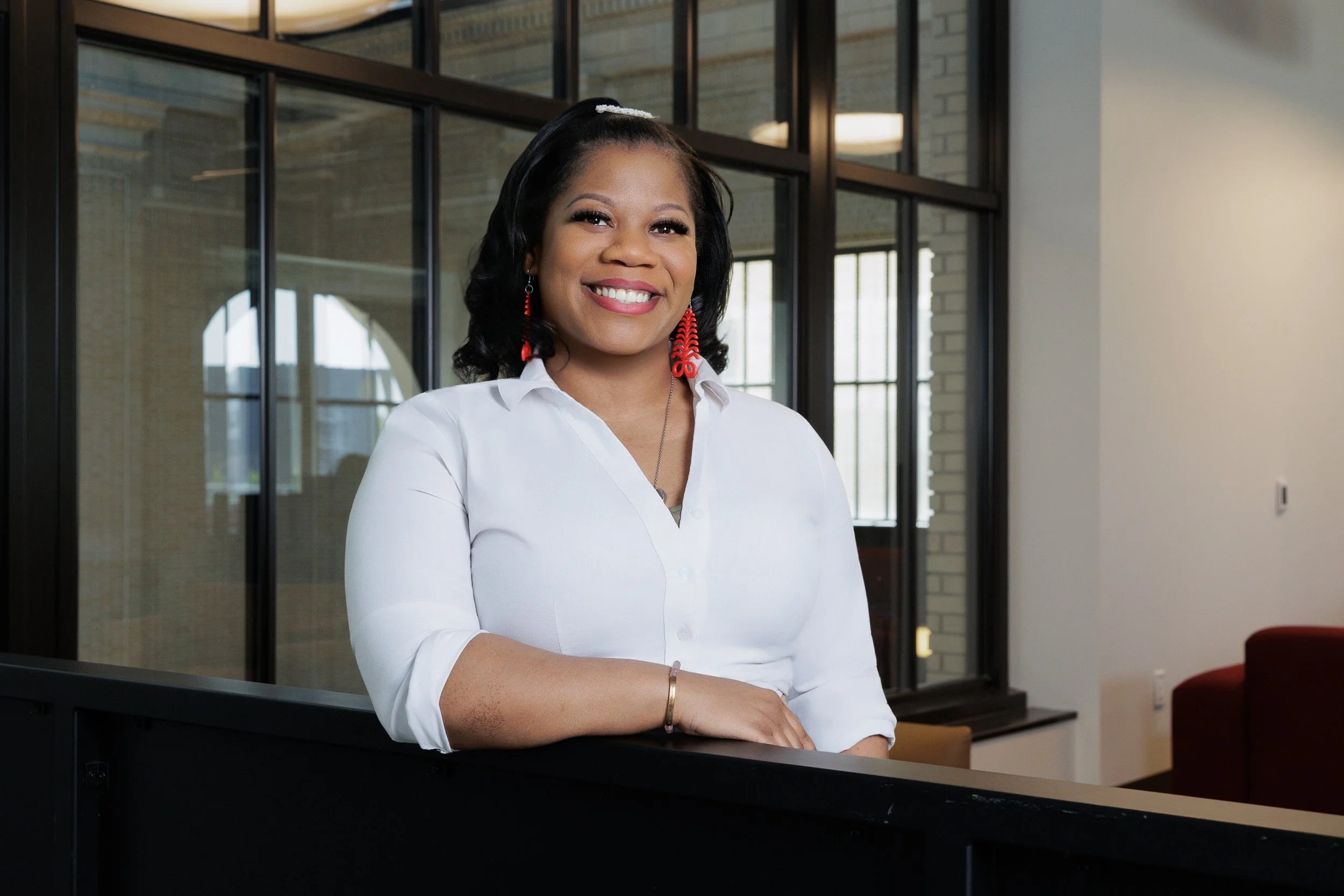
“Detroit founder TeQuion Driscoll didn’t wait for permission. Since 2019, she’s built MFCF and Aya House into the communal infrastructure Black Detroit deserves.”
Inside the Charles H. Wright Museum of African American History on East Warren Avenue, a conference was wrapping up the way these gatherings tend to wrap up — with applause, business cards, and the familiar, shared ache of people who know the work is too slow and the systems are not built to move faster. It was circa 2018. TeQuion Driscoll was in the room.
She had been in rooms like this for years. Rooms full of serious people doing serious work — philanthropists, advocates, organizers — each trying, in the phrase that circulates through foundation corridors, to move the needle. Driscoll sat in those sessions and felt something shift — not toward patience, but past it. She knew, clearly, that the needle was the wrong instrument. What these communities needed, she decided, was to bust the gauge entirely.
TeQuion Driscoll is the founder of Michigan Freedom Community Foundation — MFCF — and Aya House, both based in Detroit. She introduces herself simply: a founder, building from the inside of a city that has been asked to wait long enough.
But the fuller shape of who she is becoming is this: an architect of equitable community infrastructure — building the systems, institutions, and relationships Black communities need to care for themselves, solve problems, build wealth, and advance racial justice. That is not a mission statement borrowed from a funder's vocabulary. It is the operational description of what she is actually constructing, brick by unglamorous brick, since 2019.
The problem Driscoll is solving is not new. But it is urgent in ways the data make concrete.
Black households in Detroit continue to face significant income and wealth gaps relative to their white counterparts — a disparity rooted in documented decades of redlining, disinvestment, and exclusion from asset-building systems. According to the Urban Institute, the national Black-white wealth gap remains one of the most persistent structural inequalities in American economic life, with the median white family holding roughly eight times the wealth of the median Black family. Locally, Detroit's majority-Black population inherits that national pattern in concentrated form — a city whose recovery narrative has often centered investment that bypassed the residents who stayed.
At the capital formation level, the picture is just as stark. Black founders receive less than 1% of venture capital nationally — a figure consistent across multiple years of Crunchbase and BLCK VC reporting — and philanthropic capital, the resource most available to community-serving organizations, has historically flowed through gatekeeping structures that reward credentialed intermediaries over proximity to need. The problem, as Driscoll frames it, is not a shortage of ideas, talent, or leadership in Black communities. It is the absence of trusted infrastructure — the kind that moves capital, knowledge, space, and opportunity closer to the people closest to the work.
That gap is what she decided to fill.
The friction was not only financial. Driscoll describes something more systemic: a credibility tax levied by philanthropic and civic institutions on Black leaders seeking access to resources.
She watched Black-led organizations be asked repeatedly to prove their pain, demonstrate their scale, and signal their readiness — to systems that were structurally designed to distrust them. The logic of access, she saw, was being applied as if it were charity rather than what it actually is: infrastructure. The gatekeeping was not accidental. It was built in. And it landed hardest on the people doing the work closest to the community — the ones with the deepest knowledge and the thinnest margin for error.
That recognition was the friction that became a blueprint.
In 2019, Driscoll founded MFCF. She seeded the early operations herself — with income from her position at the McGregor Fund — and built the initial infrastructure through a combination of tools available to any determined organizer on a constrained budget: TechSoup for nonprofit software access, LinkedIn and VolunteerMatch to recruit talent and volunteers, and what she describes as relationship capital — the compounding resource that cannot be purchased but can be built through consistency, clarity of mission, and the unglamorous work of showing up.
She launched Aya House as a physical and institutional expression of the same logic: a home for the infrastructure, not just the idea.
The hard lesson Driscoll names is the one that separates community-rooted builders from efficiency-obsessed ones. Building with community is slower than building for it. She chose the slower path — what she calls moving at the speed of trust rather than the speed of bureaucracy. And she learned, through that choice, that relationship capital compounds faster than financial capital. The strongest institutions, she found, are not built on money first. They are built on people who believe in the mission before the metrics exist to justify it.
The receipts are accumulating.
Since founding MFCF in 2019, Driscoll has helped mobilize millions of dollars in philanthropic, earned, and debt capital for community organizations and social causes (self-reported). The organization has built a community of more than 80 member organizations (self-reported), secured more than $300,000 in grants for the 2025–2026 period (self-reported), and launched the Detroit Love Fund — a direct investment vehicle for Detroit residents. In 2026, MFCF will serve 100 Detroit youth through its inaugural DiscoverWorks summer workforce program (self-reported).
These are not vanity metrics. In a landscape where Black-led community organizations are routinely undercapitalized and under-resourced relative to the scope of need they address, building a coalition of 80-plus organizations and crossing a $300,000 grant threshold in a single funding cycle represents real institutional formation — the kind that most funders want to see before they fund it.
What Driscoll is building carries a significance that extends past any single organization's balance sheet.
The question she is answering is not only "how do we help Detroit?" It is a harder, longer question: what does it look like when Black communities inherit infrastructure instead of inspiration? When the next generation of Black leaders in Detroit doesn't have to spend the first decade of their careers rebuilding what should have already existed — the funds, the networks, the institutions, the relationships with capital — and can instead spend that decade solving new problems?
That is the shift. From a civic ecosystem where belonging has to be earned again, in every generation, by every new founder — to one where infrastructure is already in place, already trusted, already working. That ecosystem does not just serve Detroit. It models something the national movement for economic equity has been trying to describe and fund and theorize for years: that proximity to the problem is not a liability. It is the qualification. And when we resource it accordingly, the whole community's ceiling rises.
If you believe Detroit's future is built by and with the people who know it best, then the work TeQuion Driscoll is doing is not a niche cause — it is the foundational work the ecosystem requires.
Visit www.mifreedomcf.org to become a partner, donor, or volunteer. The infrastructure is under construction. It needs more hands.
