
Joshua Ashford Is Building Detroit's First LAN Center for Its Youth
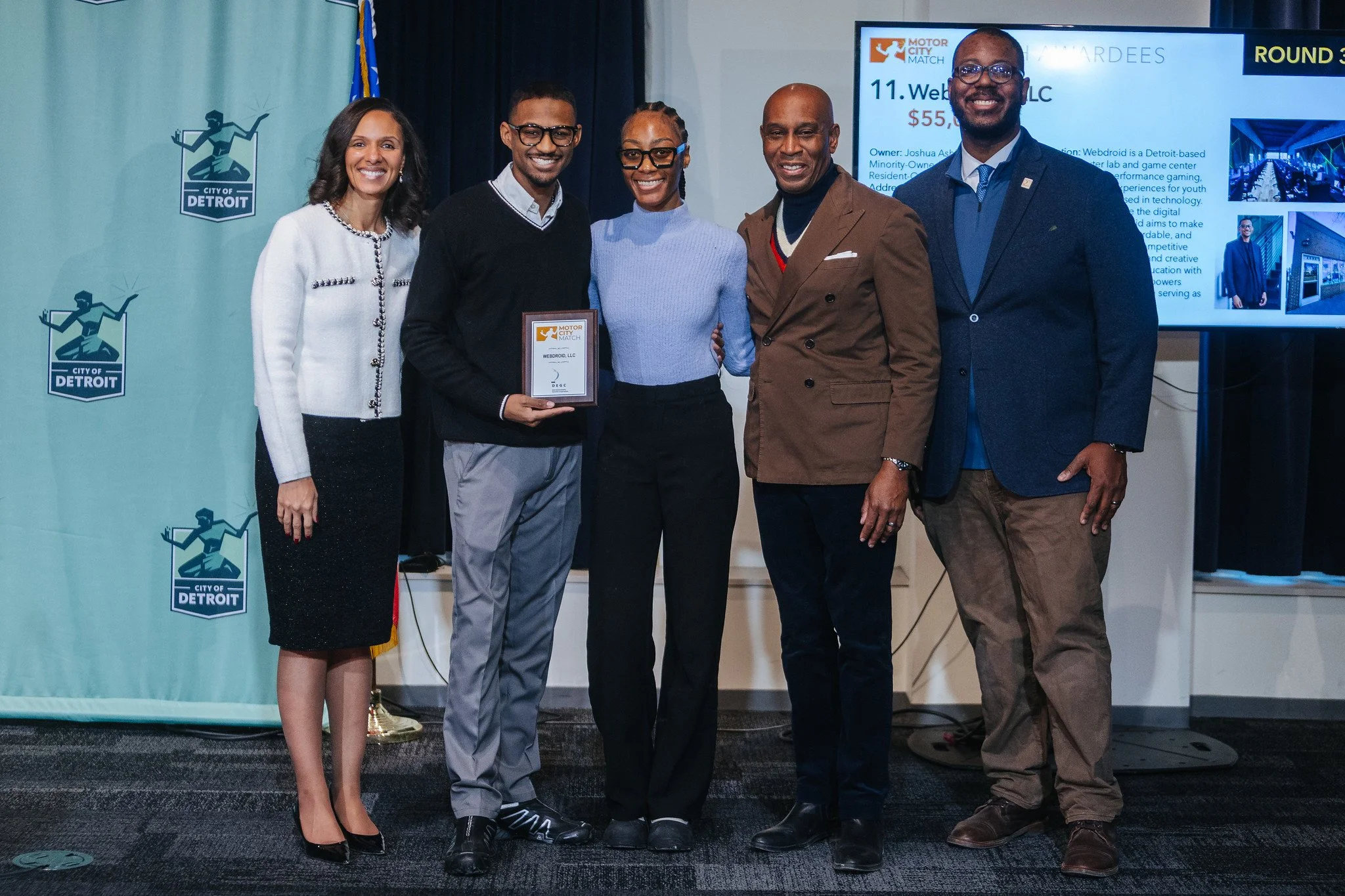
“Former Detroit coding teacher Joshua Ashford invested $250K to open Webdroid Esports Computer Lab — Detroit’s first LAN center — and the city’s next generation is waiting.”
It is a Tuesday afternoon inside a commercial space on a walkable stretch of Detroit, and Joshua Ashford is still not open. Not yet. The buildout is complete. The high-powered PCs are coming. The permits are finally through. He has been paying $4,000 a month in rent for over a year to hold this space — $50,000 spent before a single young person has walked through the door — and he is still here, still building, still exactly where he said he would be.
That is the story. Not the delay. The decision to stay.
Joshua Ashford introduces himself the way a man does when he means it: Founder and CEO of Webdroid, LLC, and the Webdroid Alliance Non-Profit Organization, based in Detroit. He is also a former coding instructor who taught at Detroit Central, Mumford, and Martin Luther King High Schools, and with the Boys & Girls Clubs of Southeastern Michigan and Apple Education — and he left classroom teaching not because he was done with students, but because he realized one classroom was not enough.
He is becoming, in his own words, Detroit's premier expert on esports and tech education, with a specific focus on youth programming. That is not a LinkedIn tagline. That is a declaration of trajectory — the kind you make when you have already spent a quarter of a million dollars proving you mean it.
The city Ashford is building in does not make this easy — and that difficulty is not incidental. It is structural.
Detroit youth face a technological disadvantage that begins before they ever set foot in a classroom or a gaming chair. According to Federal Communications Commission data from 2023, Detroit youth have approximately 40% lower broadband access than their suburban peers — a gap that compounds every year as the professional and educational economies move further online. Fiber infrastructure, the backbone of competitive internet access, remains sparse inside city limits.
The workforce consequences are downstream but predictable. Black professionals account for roughly 7% of the national tech workforce, according to Bureau of Labor Statistics data — and receive just 1% of venture capital funding, per long-standing analysis from the Kauffman Foundation and subsequent reporting. Detroit's young people are not simply starting behind in a fair race. They are being excluded from the starting line by a combination of infrastructure neglect, capital disinvestment, and an almost total absence of third-place spaces where tech culture and youth culture meet on young people's own terms.
That absence is the problem Ashford is solving.
The barrier, for Ashford, has been the grind of infrastructure itself. Raising a quarter of a million dollars is one kind of hard. Navigating Detroit commercial permitting is another. He describes the process of opening Detroit's first LAN center as a "10 out of 10 in difficulty" — not because of any single obstacle, but because of the compounding effect of timelines that slipped, parties that missed deadlines, and the relentless cost of holding space while the city's machinery moved at its own pace. He has finally cleared permitting. He is targeting a July opening. But the gap between the vision and the certificate of occupancy cost him a year and $50,000 in rent he will never get back.
He is clear-eyed about it. And he kept paying.
The idea itself arrived the way most transformative things do: in a conversation no one was planning on having.
March 2020. The pandemic had just shut the world down. Ashford was sitting on the porch of his Detroit home when his brother Ryan — who has lived in China since 2014 — mentioned he was thinking about returning to Detroit to open a LAN Center, the kind of high-traffic, high-energy communal gaming spaces that have been common across East Asia for decades and are virtually nonexistent in American inner cities.
Ashford says the recognition was immediate: That is what my students need right now. He asked his brother if he could steal the idea. Ryan said yes — as long as Ashford actually did it.
He has been doing it since.
He did not wait for external validation before he started building. In 2021, Ashford entered the TechTown Detroit Retail Bootcamp business accelerator, won, and received a $5,000 grant (self-reported) — a sum that mattered less as capital than as institutional confirmation that what he was building had legs. That same year, he pitched the Boys & Girls Clubs of Southeastern Michigan on adopting his esports programming initiative. The partnership worked. Together, they raised $600,000 (self-reported) toward the development of four esports labs across BGCSM facility locations.
The proof of concept landed. The program Ashford launched inside those Boys & Girls Club spaces taught high school youth not just how to play competitively, but how to operate as owners — recruiting players, building rosters, managing teams across club locations like a sports general manager. The kids showed up. The model worked.
The lesson he is still processing: he wishes he had pursued ownership of his commercial space rather than renting it. Twelve months of $4,000-per-month rent while permits moved and timelines stretched taught him, the hard way, that investing in a space you do not own is a different kind of risk than the kind that shows up in a business plan.
The numbers Ashford has built on are real, even if some are still self-reported ahead of an independent audit trail.
He has invested a quarter of a million dollars into his Webdroid location as of June 30, 2026 (self-reported). He helped raise $600,000 in partnership with BGCSM toward four esports labs (self-reported). He won a competitive business accelerator in 2021 (verified, TechTown Detroit). He has paid over $50,000 in rent before opening a single day of business (self-reported). Detroit's broadband gap — 40% lower access for city youth compared to suburban peers — is documented by the FCC (verified, public).
These are not ambitions. They are the record of a man who has already paid to get here.
When Webdroid opens — and it will open — it will be the only space of its kind in the city of Detroit. Not just the first LAN center, but a deliberately designed third place: somewhere between school and home, between recreation and career, between a kid who games and a young adult who understands the industry that gaming is building. Ashford envisions pay-to-play access on high-powered PCs, alongside design and programming software, coding workshops, and competitive tournaments — all under one roof, in a walkable neighborhood, priced and built for the young people who live there.
The research on what third-place spaces do for urban youth is not ambiguous. Belonging creates builders. When young people see themselves in a space — really see themselves, as participants and potential owners and not just consumers — the downstream effects on educational persistence, career aspiration, and civic attachment are measurable. Ashford spent years teaching that truth in classrooms at Central, Mumford, and King. He is now building infrastructure to make it structural rather than individual, scalable rather than singular.
Detroit's economic future depends on diversifying its talent pipeline into the tech sector. That is not a theory — it is what every workforce development report written about this city in the last decade has concluded. What those reports rarely solve for is the infrastructure gap at the youth level: the absence of spaces where young people from the city's east side can encounter tech culture as something that belongs to them. Webdroid is one answer to that gap. But it only works if the city — its institutions, its brands, its press — treats it like the civic infrastructure it is.
If you are rooting for Detroit's next generation to have a seat at the tech table, the ask right now is simple: go to Webdroid's website and sign up as a beta tester before the July launch. Not as charity. As a signal — to Joshua Ashford, to Detroit, and to every young person in this city who has been told that the gaming chair, the code editor, and the tournament stage are not for them — that you are ready for what comes next.
Visit webdroidonline (https://www.instagram.com/webdroidonline) on Instagram or webdr01d (https://www.facebook.com/webdr01d) on Facebook to follow the launch. Beta tester registration is open now.
