
Michael Hale Jr. Is Building the Trust Infrastructure Detroit's Tech Future Runs On
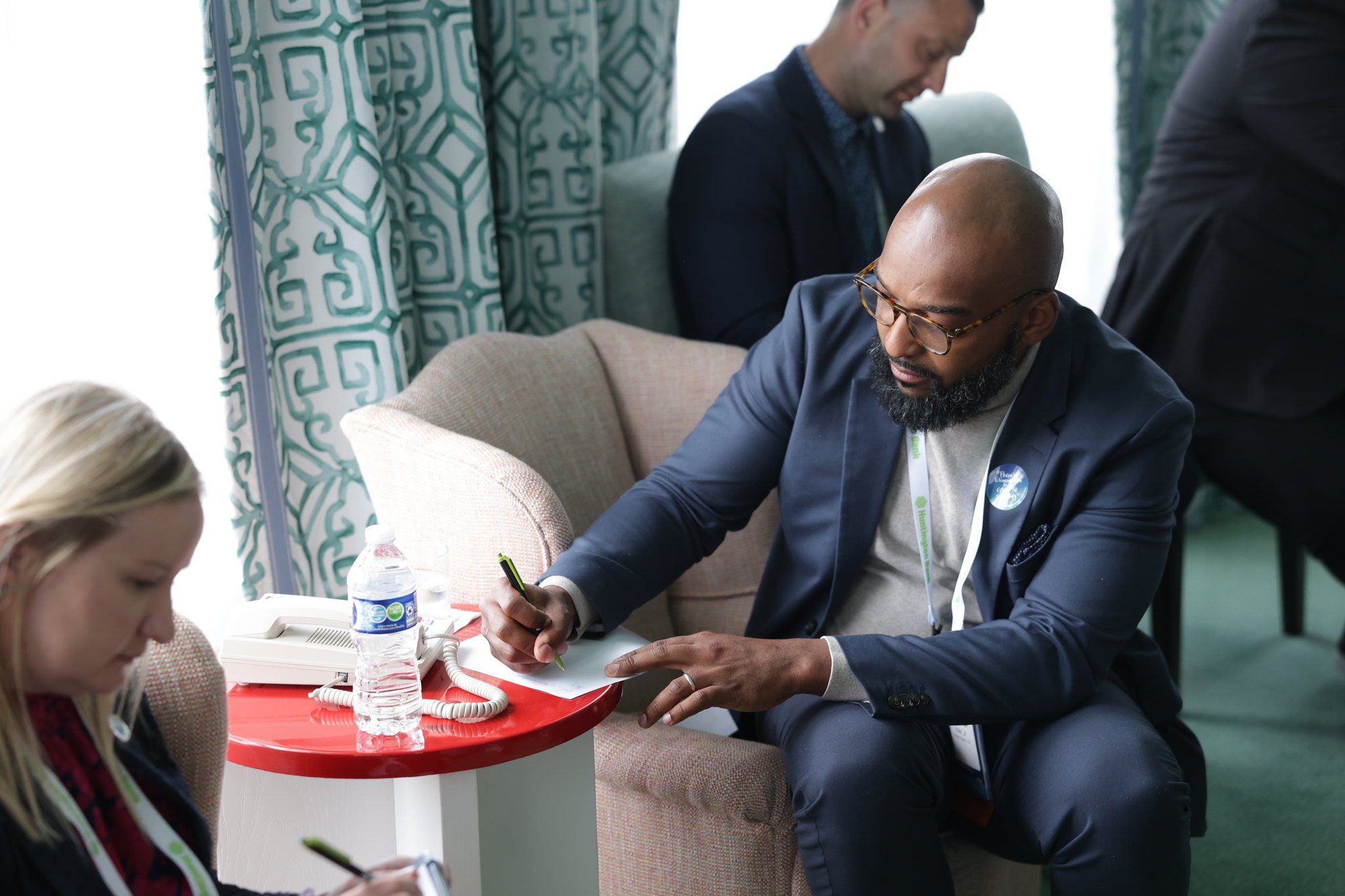
“Atomic Object’s Michael Hale Jr. is mapping Detroit’s innovation ecosystem one deep relationship at a time — and proving that trust is the real infrastructure.”
It is six in the morning in Atlanta, October 2025, and Michael Hale Jr. is three miles into a run. He is not there for a conference. He bought the ticket himself. He came to understand why Atlanta was moving — not faster than other cities, but differently. The answer arrived mid-stride: two people on the same pavement, same sunrise, handshake, done. A deal closed between footfalls. Later that day, a leader at Partnership for Innovation filled in the architecture behind the moment. In Georgia, corporations, civic leaders, foundations, and universities had found a way to agree on what mattered — past personal agendas, past competing panels, past the performance of alignment. They were actually aligned. He had just run through the evidence. That night, Hale found himself inside a private VC happy hour — "I'm not a VC, for the record," he'll tell you — absorbing an unfiltered seminar in capital strategy from people with nothing to prove and nothing to hide. He flew home with a corrected hypothesis. He had been asking why Atlanta was so fast. The better question was how Atlanta got so trusting. Speed, he realized, is just what trust looks like from the outside. Michael Hale Jr. (link to profile) is the Business Development Lead for Atomic Object in Detroit — a software product firm that builds custom software for complex enterprise problems. But the title undersells the work. He is, by his own account, becoming "the most important voice in Detroit's transformation by building the kind of infrastructure that doesn't show up on a map — the rooms, the trust, and the language that turns this city into a proof of concept for the whole country." That is not a mission statement crafted for a LinkedIn bio. It is a job description for something that does not yet have a formal name: the person who builds the civic connective tissue before the builders arrive. The person who makes the rooms possible so the deals can happen inside them. Detroit is not a city in decline arguing for a second chance. It is a city in transition arguing about the terms. The region is projected to add more than 20,000 tech jobs and $6.8 billion in wages as legacy industries accelerate their digital transformation — figures cited by Detroit's own regional economic development planning. Software has stopped being an IT line item. It has become critical infrastructure: the operating system beneath manufacturing, healthcare, logistics, and civic services. The urgency is structural. According to McKinsey Global Institute research, roughly 70 percent of large-scale technology transformations fail to meet their objectives — with organizational complexity and misaligned stakeholders among the leading causes. For Detroit's legacy institutions — mid-sized manufacturers, regional health systems, municipal agencies — the cost of getting modernization wrong is not a bruised quarterly report. It is operational failure, workforce disruption, and years of stalled progress. At the same time, the Bureau of Labor Statistics consistently shows that Midwest tech ecosystems lag coastal markets in venture capital density and enterprise software adoption rates, creating a structural gap between the pace of innovation in cities like Atlanta or Austin and what legacy-industry cities have historically been able to absorb. Detroit's transformation is not just about adding tech jobs. It is about building the institutional trust infrastructure that makes those jobs possible and durable — the kind of alignment that lets a deal close on a morning run because the relationship was already there. That is the gap Michael Hale Jr. is building into. The friction was not a single wall. It was an accumulation of smaller ones. Legacy technology environments inside Detroit's major institutions mean that modernization conversations carry existential weight — a failed implementation doesn't just cost money, it can cost a CIO their credibility or a department its function. That raises the threshold for trust before any vendor conversation can begin. Institutional complexity compounded it. Detroit's civic and corporate ecosystems are dense with overlapping stakeholders, competing mandates, and organizations that have learned, through hard experience, to be cautious about outside partners promising transformation. The city has seen enough consultants and platforms arrive with ambition and leave without accountability. For Atomic Object — a firm building in Detroit from outside the city's legacy network — the question was not whether the product was good. The question was whether anyone in the room had enough reason to believe the relationship would hold. The Atlanta run was a confirmation, not a conversion. The hinge had come earlier — in the accumulation of first meetings that felt productive and led nowhere, in the calendar full of energy that never converted to movement. Hale had been optimizing for access. He had been in the right rooms with the right people, and the rooms kept not opening into anything. The choice was to stop optimizing for volume and start optimizing for depth. To ask not how many but who, actually, can open a door — and to learn to tell the difference between someone excited about a conversation and someone capable of moving something inside a bureaucracy. They look identical in the room. They are not. Atlanta confirmed what that choice had to look like at scale. Someone had built trust there, intentionally, over time, before the speed was visible. Hale flew home and got to work building the same thing in Detroit. He started by securing a desk at JHub, Invest Detroit's innovation hub on the ground floor of Detroit's financial district. Not a conference table. A desk — a consistent physical presence in an institution that already held relationships he needed to earn. From that base, he mapped thirty Detroit institutions with real innovation mandates and started booking five to ten listening meetings a week. Not pitching. Listening. Atomic Object's name rarely came up in the early months. The point was to understand what Detroit's digital leaders were actually afraid of, actually accountable for, and actually capable of moving. In May 2026, he was accepted into Mackinac Policy Conference's Future Leaders Cohort — a program that, he notes, compressed years of relationship-building into months. The compressed timeline matters: relationship-led growth in a legacy-industry city does not move fast on its own. The cohort created structural proximity to decision-makers who might otherwise take three years to get to a second conversation. He tracked every signal in HubSpot — not as a CRM exercise but as discipline. A calendar full of first meetings is not a pipeline. He had learned that the hard way. The database was a forcing function for honesty about where things actually stood. The hard lesson he carries: enthusiasm from a contact is not the same as a champion. People can genuinely like you, genuinely believe in what you're building, and still never move anything internally. Learning to read that difference — before investing months in a relationship that will not convert — is not cynicism. It is the craft of the work. The skeptical version of relationship-led business development is that it is slow, unverifiable, and dependent on personality rather than process. The numbers Hale has assembled since January 2026 are an argument against that skepticism. By mid-2026, he had established three institutional anchors — Invest Detroit, Innovation Alliance Michigan, and JHub — that provide ongoing structural access to Detroit's innovation and capital networks. He carries eight or more named senior contacts at the VP level and above across Detroit enterprises. Six active enterprise threads are in motion. Atomic Object had multiple active enterprise engagements underway by mid-2026. The Detroit Tech Leaders Dinner (TLD) — a curated dinner series Michael Hale Jr. runs that brings together corporate entities, universities, risk capital, government, philanthropy, and operators — held its most recent Detroit dinner on July 22, 2026. The MVCA Summer Cruise, a Michigan Venture Capital Association networking event, was on the calendar for August 6, 2026, adding another institutional node to the network. These are not the numbers of someone who was in a lot of rooms. They are the numbers of someone who learned the difference between being in a room and building one. When Michael Hale Jr. describes what changes for the next person, he is precise about it: the next business development lead handed a new market in Detroit will not start from zero. They will inherit a playbook. Real contacts who already know Atomic Object. Institutional anchors that took months to establish. A reputation in the room before they ever walk in. That is not a small thing. In a city where the cost of starting over is measured in years — where trust is not assumed and relationships are not transferable without proof — a documented, functional playbook for relationship-led enterprise growth is the difference between a company that can scale its presence and a company that has to re-earn its credibility every time a new face shows up. But the significance runs past Atomic Object's pipeline. Detroit's tech transformation is not primarily a capital problem or a talent problem. It is a coordination problem. The institutions that need to modernize, the capital that needs to deploy, and the builders who need to be trusted are all present in this city. What has been missing is the infrastructure of trust that lets them actually work together — the rooms, the relationships, and the shared language that Atlanta built over a decade and Detroit is building now. Every city trying to turn a legacy-industry economy into a tech economy is watching. Detroit, if it gets this right, is not just a comeback story. It is an instruction manual. The work Michael Hale Jr. is doing in Detroit is not invisible — but it is easy to overlook if you're only counting product launches and funding announcements. The trust infrastructure rarely makes headlines until the deal closes and someone asks how it happened. So here is the ask, direct and simple: if you believe in Detroit's tech future, share this with one person in this city who is making decisions about technology, infrastructure, or what this city becomes next. Not to sell them anything. Just to make sure they know someone is building the rooms — and that the rooms are open.
