
Banks Couldn't Lend on What They Couldn't See. So He Built the Way to See It
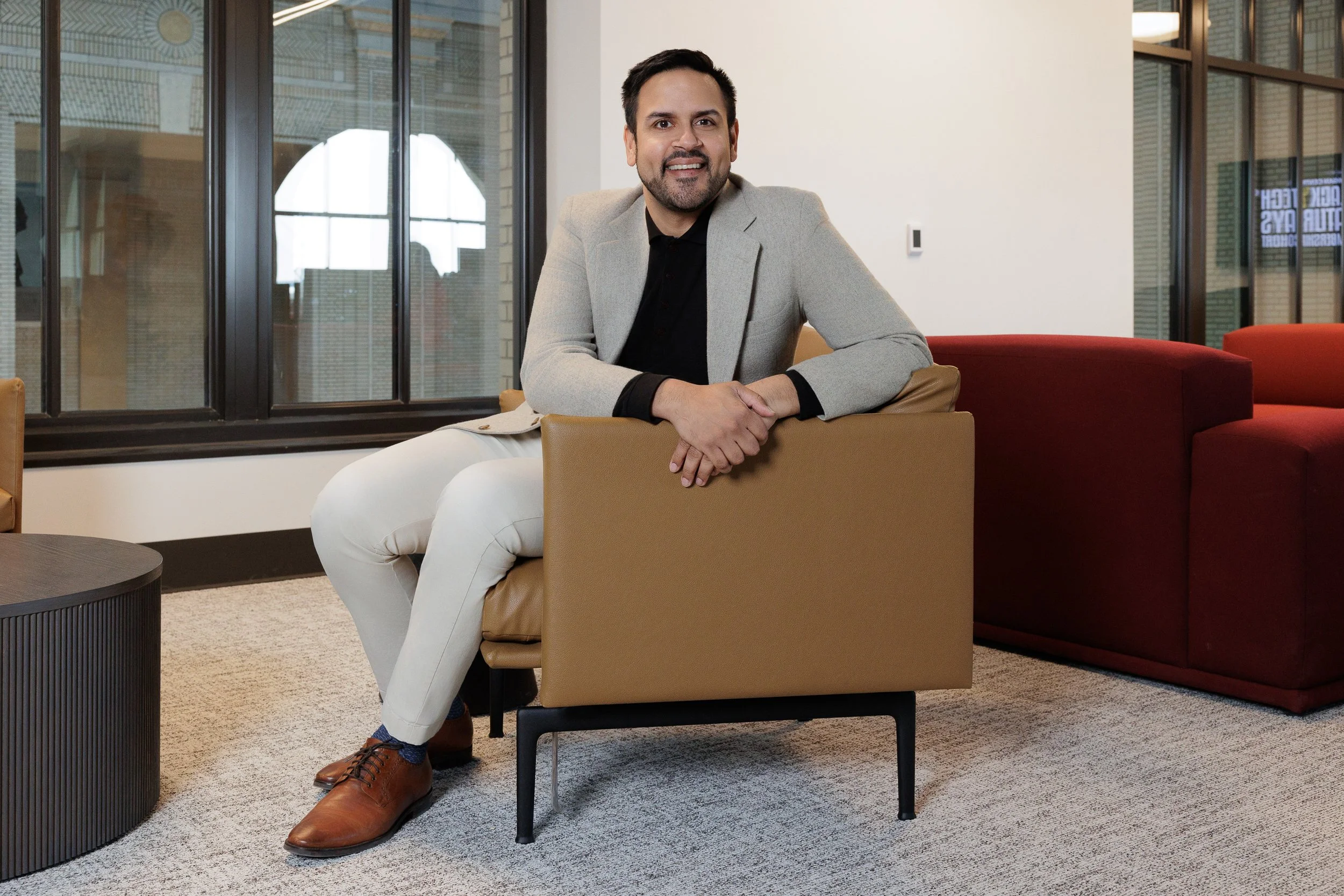
“Nishant Dixit left a slide deck behind on a Detroit factory floor and came back with a mission: turn manufacturing data into capital banks can’t ignore.”
Inside SMT Automation, the CNC machines don't stop. Automated cells cycle through their routines. Engineering displays pulse with live data. The floor is exactly what politicians mean when they invoke American manufacturing — precise, costly, irreplaceable.
Nishant Dixit was standing in the middle of it, and he wasn't talking about technology.
He was talking to Elena Morales and Marco Antonio Santana Carrasco — engineers who had built this operation from nothing — and they were telling him, plainly, that the operation might not survive. Payment terms had stretched from Net 90 to Net 120. A financial institution had just pulled their credit line, citing insufficient contract volume. The cruelty of that logic was not lost on anyone in the room: losing the credit line made them ineligible to bid on the very contracts that would have justified it.
Marco looked at Nishant across the noise of the floor and said what the spreadsheets could never say: "I can do a deal for automotive suppliers or a deal for automotive partners, but not both at the same time."
In that sentence, a $4 billion regional crisis stopped being a statistic. Elena and Marco had escaped cartel violence in Juárez. They had built a multi-million dollar manufacturing operation in Detroit. They were calculating whether to sell the building they were standing in so they could pay their children's college tuition. And the banking system — the same system that benefits from their contracts, their compliance, their precision — had decided it couldn't see them well enough to lend.
That gap between what manufacturers produce and what banks recognize is where Alisio was born.
Nishant Dixit is the co-founder and CEO of Alisio, based in Detroit. He is becoming an infrastructure builder — constructing, in his own framing, "the financial rail that solves the multi-billion working capital gap for the world's largest trade relationship."
That trade relationship is the United States and Mexico. The rail is an AI intelligence layer that converts compliance and factory floor data into a bankable, verifiable asset. The ambition is not incremental. It is architectural. Nishant is not trying to help manufacturers get loans faster. He is trying to change what counts as collateral — and who gets to count.
Mexico became the United States' largest trading partner in 2023, surpassing China for the first time in over two decades. The political conversation around that shift centers on nearshoring, supply chain resilience, and USMCA compliance. The operational reality is something more elemental: the factories making this shift possible cannot get paid on time, and they cannot borrow against the work they are already doing.
Parts in the modern supply chain cross international borders up to 16 times before final assembly. The Tier 2 and Tier 3 suppliers handling those crossings — the machine shops, the stamping operations, the fabricators — routinely wait 90 to 120 days for payment. In Michigan alone, that liquidity bottleneck has produced a $4 billion working capital gap, according to research from Next Street. Globally, small and medium-sized manufacturers face a financing gap estimated at $1.1 trillion by the Asian Development Bank.
The reason banks don't fill that gap is not indifference. It is architecture. Legacy commercial lending models were built to read static balance sheets, not real-time factory floor data. When a Tier 2 supplier's primary asset is a purchase order from a Tier 1 OEM — combined with a track record of cross-border compliance that exists in unstructured, fragmented documentation — the bank's underwriting system has no framework to recognize it. So it doesn't. The credit line gets frozen. The business calculates what it can sell.
This is not a Detroit problem. But Detroit makes it visible.
The friction Nishant encountered came from two directions simultaneously, and they had almost nothing in common except the word "no."
The first was geographic dismissal. A California venture capitalist, hearing that Nishant was calling from Detroit, laughed and called it "ghetto." The condescension was casual, which made it more instructive than insulting. Coastal capital has a geography of imagination, and the industrial Midwest rarely appears on it.
The second barrier was structural and far more consequential. Legacy commercial banks were not hostile to manufacturers like Elena and Marco — they were blind to them. Institutions that cannot parse cross-border compliance documentation, that cannot read purchase order data as a bankable signal, that cannot verify what a factory floor is actually producing and for whom — those institutions freeze. And when they freeze, they don't just decline a loan. They pull the existing line. They trigger the death spiral Marco described on the factory floor: no credit means no bids, no bids means no contracts, no contracts means no credit.
According to data from the Goldman Sachs 10,000 Small Businesses initiative, 81% of small business owners attempting to secure a loan report difficulty accessing affordable capital. The downstream effects are not abstract: 49% are forced to halt expansion plans immediately, and more than 40% are blocked from taking on new business entirely. Nishant saw both numbers embodied in two engineers standing in a factory they'd built, doing the math on whether to sell the building.
The hinge was not a quiet moment. It came from a purchasing agent — someone inside the supply chain system, not outside it — who said, without apparent discomfort, that "you haven't made it in purchasing until you've put someone out of business."
That sentence, heard against the backdrop of Elena and Marco's situation, made the abstraction collapse. Nishant had been mapping a market. He became, in that moment, committed to building infrastructure. The difference between those two things is the difference between a consultant and a founder. He chose the second.
Nishant started with interviews, not code. Fifty of them — raw, operational conversations with manufacturing operators designed to map the exact bottlenecks where capital freezes and compliance breaks down. That fieldwork produced something more valuable than a product spec: it produced trust, and with it, a formal data-sharing agreement granting access to a historical dataset of 170,000 cross-border manufacturing transactions for model training.
He built the first prototypes himself. His co-founder Manuel Zamora — formerly of StructionSite — taught him to work with Claude and Cursor, and they established a rhythm: Nishant building, Zamora hardening the commits into enterprise-grade architecture. The velocity was deliberate. In a market where institutional trust is the actual product, showing up with working software is a different kind of proof than a pitch deck.
The hard lesson, Nishant says, was that the hard part was never the AI. The real work was earning trust — simultaneously — from skeptical manufacturing operators, commercial banks, and international institutions including the World Bank and AMSDE, Mexico's association of state economic development secretaries. "Cross-border transaction verification," he reflects, "is a deep, multi-layered institutional relationship long before it is ever a software feature."
That lesson shapes everything about how Alisio is built: not as a product being sold to institutions, but as a standard being adopted by them.
The banking system's blind spot is not a perception problem. It is a documentation problem — and the market it has produced is measurable.
In Q1 2026, Alisio was named the #1 AI Agent Startup at ClawCon — described as the world's largest AI agent conference by attendee count (self-reported by organizers). That recognition converted directly into a verified $50,000 investment from eLab Ventures.
The underlying data infrastructure is anchored by a formal data-sharing agreement providing training access to 170,000 historical cross-border manufacturing transactions (self-reported). On the governance side, Alisio has been formally adopted as the transaction verification standard across all 32 Mexican state economic development networks through AMSDE (self-reported).
As of Q2 2026, the commercial pipeline includes advanced conversations with Denso — which works with approximately 3,000 Mexican suppliers — Nexteer Automotive, Toyota, Nissan, and BMW. Institutional pipeline discussions are active with the Industria Nacional de Autopartes (INA), which represents more than 1,200 manufacturers, and cross-border framework scoping is underway with the World Bank. On the capital side, Alisio is in advanced technical scoping with Pathward (NASDAQ: CASH), KeyBank, BBVA, and Banco Base for purchase order and work-in-progress financing rails, alongside active deployment integration with the MMSDC to embed the verification engine into Matchmaker365. All pipeline conversations are self-reported and pending formal agreement.
If Alisio wins, the definition of what makes a manufacturer bankable changes permanently.
That may sound like a product outcome. It is, in practice, a political one. Proposals to raise the USMCA Regional Value Content threshold to 82% mean that compliance is no longer a paperwork burden — it is an existential filter. A Tier 2 supplier that cannot continuously trace and prove its regional value-add faces tariff penalties and OEM disqualification. The factories most exposed to that risk are the same ones legacy banks have always been least equipped to serve: cross-border, mid-market, asset-rich in ways that don't appear on a static balance sheet.
When real-time purchase order data, factory floor output, and cross-border compliance documentation become a recognized, bankable asset class — when a small manufacturer in Chihuahua or Detroit can access working capital the same way a cloud company spins up a server — the geographic bias that has choked industrial finance for decades loses its foundation.
The $2.5 trillion global trade-finance gap exists, fundamentally, because of a trust deficit between local factories and the multinational institutions that could fund them. Closing that gap does not just help the next Elena and Marco. It builds the economic architecture that allows the next generation of diverse, technically sophisticated manufacturers to stay in OEM supply chains, win new contracts, and scale without choosing between growth and survival.
What Alisio is building is not a fintech application. It is permanent financial infrastructure for the operators who actually build the world — and a proof of concept that technical founders in Detroit belong at the center of that work, not the margin of it.
The manufacturers making the U.S.-Mexico trade relationship run are not asking for a movement. They are asking to get paid on time. They are asking for a bank that can see what they built.
If you believe the backbone of American manufacturing deserves a financial system that can read it — visit alisiofi.com and introduce Alisio to one manufacturer or commercial bank drowning in cross-border supplier paperwork. That introduction is how the rail gets built.
