
Diop Shamuke is Building What the Wearable Market Forgot
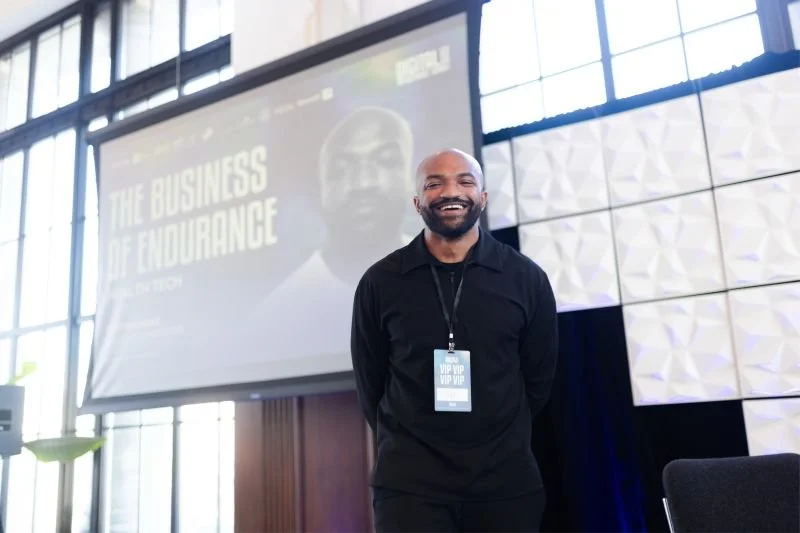
“A Detroit founder is connecting federal environmental data to personal biometrics — because 72 million Americans deserve to know what their block is doing to their body.”
Belle Isle, Detroit. 2023. A founder is running.
Not at a conference. Not in a pitch meeting. On an island park in the middle of the Detroit River, surrounded by trees and open water, moving through air that felt different from the air in the neighborhoods just across the bridge. The body noticed before the mind did — the pace was easier, the breath was cleaner, the recovery felt different.
That gap between what the body felt and what no device could explain became the question that wouldn't let go.
The founder behind ENDO describes the arc plainly: becoming more refined by building ENDO and leading an agency.
That word — refined — is doing real work. Not disrupting. Not scaling. Refining: the deliberate process of removing what doesn't belong until what remains is true. It's a builder's word, and it maps to what ENDO actually is — not a consumer gadget, not a wellness app, but infrastructure. The kind of infrastructure that takes years to get right and, if it holds, outlasts the person who built it.
The executive director of Kairos Research is building in Detroit, without Silicon Valley, without a computer science degree as the entry credential, and without a single incumbent in the wearable health market as a model. That is the point.
The United States has a $23 billion wearable health market — a figure reached in 2024 and projected to double by 2030, according to published industry tracking. Those devices are sophisticated. They monitor heart rate, sleep cycles, blood oxygen, stress signals. They have gotten very good at telling you what your body is doing.
Not one of them tells you what your environment is doing to your body.
That omission is not a design oversight. It is a structural gap with documented consequences. The EPA estimates that 72 million Americans live in areas with persistently poor air quality. CDC data shows that residents of environmentally burdened neighborhoods develop cardiovascular disease at twice the national rate. Municipal health departments spend billions annually on reactive treatment — emergency care, chronic disease management, downstream intervention — while the environmental data driving those outcomes sits unused in federal databases, formatted for regulators, accessible to almost no one else.
The data exists. The hardware exists. The demand exists.
What doesn't exist yet is the infrastructure that connects them at the block level, in real time, in a way that a person — not a policy analyst — can actually use.
Environmental health data was built for compliance, not for communities.
Wearable technology was built for the consumer wellness market — a market historically shaped around users who could afford premium devices, lived in zip codes with existing health infrastructure, and were not the populations most exposed to environmental harm.
The result is a system where the people who most need to understand what their environment is doing to their health have the least access to that information. Incumbents sold to governments. Nobody built for the gap in between. That gap is not a niche. It is 72 million people.
The run on Belle Isle was not a pivot. It was a recognition.
The connection between environment and physical performance was not abstract — it was felt, in real time, in a body moving through a specific place on a specific day. The question that followed was structural: if the environment shapes the body's performance that directly, why does no tool account for that relationship? And if no tool accounts for it, who builds one?
The decision to build was the decision to answer that question seriously.
Week one: enrolled in the Apple Developer Academy with no background in Swift. The program, as the founder describes it, taught a way of thinking — hardware and software as a single decision, not two separate problems.
The first commit was a single EPA AirNow API call. The return value was an AQI integer. The output was a color-coded dot rendered on a custom watchOS Canvas view — no library, no template, just coordinate math and a result on screen. That dot was the proof of concept.
From there, the build stacked: biometrics from the Apple Watch sensor pipeline, live data from federal public health platforms including CDC PLACES, device-to-device communication bridging the watch and the phone in real time. Seven federal public health platforms integrated (self-reported). Each integration, as the founder puts it, was a decision about what the user should never have to think about.
The zone classification algorithm is the current frontier — multiple live public health data sources collapsing into a single block-level score: hostile, moderate, or supportive. Rendered on a map. No user input required.
Still building. Still stacking.
The hard lesson arrived before the MVP did. Months spent perfecting the technical architecture — and then the recognition that the product would only matter if the people inside the data trusted the person collecting it. As the founder put it directly: "Build the relationship before you build the feature." The community wasn't a user base to be acquired. They were the reason the infrastructure had to be right.
Dismissing deep infrastructure built by a solo founder in Detroit as a side project would be a mistake.
ENDO's MVP is built and functional as of 2025 (self-reported). The application integrates data from seven confirmed federal public health platforms (self-reported), including EPA AirNow and CDC PLACES. Pre-seed funding has been secured (self-reported). Detroit deployment is targeted for Summer 2027 (self-reported). The wearable health market context — $23 billion in 2024, projected to double by 2030 — is drawn from published industry data. The EPA and CDC figures on environmental burden and cardiovascular disease rates are from publicly available federal reporting.
The infrastructure is not hypothetical. It is in code. It is in the watch.
When ENDO reaches a Detroit neighborhood, something structural shifts.
The next person living on a block with documented air quality problems will have proof — not a pamphlet, not a public health campaign, but real-time, block-level data — that their environment is measurable, that the data about their specific address exists, and that someone built a way to access it. They will not have to wait for a government report or a hospital diagnosis to know what their surroundings are doing to their health. The relationship between place and body will be visible, in their hands, on their wrist.
And the next founder who looks like this one — building deep infrastructure, in Detroit, without a Silicon Valley address — will have proof that the geography of innovation is not fixed. That the tools to build something that matters at national scale can come from the Apple Developer Academy, from Belle Isle, from a first commit that was nothing but a dot on a screen.
Detroit's economic future depends on diversifying not just who works in tech but who builds the infrastructure that tech runs on. When we concentrate that power in the hands of a few markets, a few networks, a few zip codes, we limit what gets built and who it gets built for. Seventy-two million people in environmentally burdened communities are not an edge case. They are a mandate.
The data exists. The hardware exists. The MVP is built. What ENDO needs now is the capital and technical partnerships to take it from a proof of concept to a deployed system.
If you believe that community health infrastructure should be built by people who understand the communities it serves — reach out directly at info@kairosresearch.co. Ask for 30 minutes.
And if you are rooting for Detroit to prove that the next generation of health infrastructure can be built here, by founders like this one, then show up for it before it needs you. That is how movements become markets.
