
Britney Epps Is Building Detroit's First Sustainable Fashion House
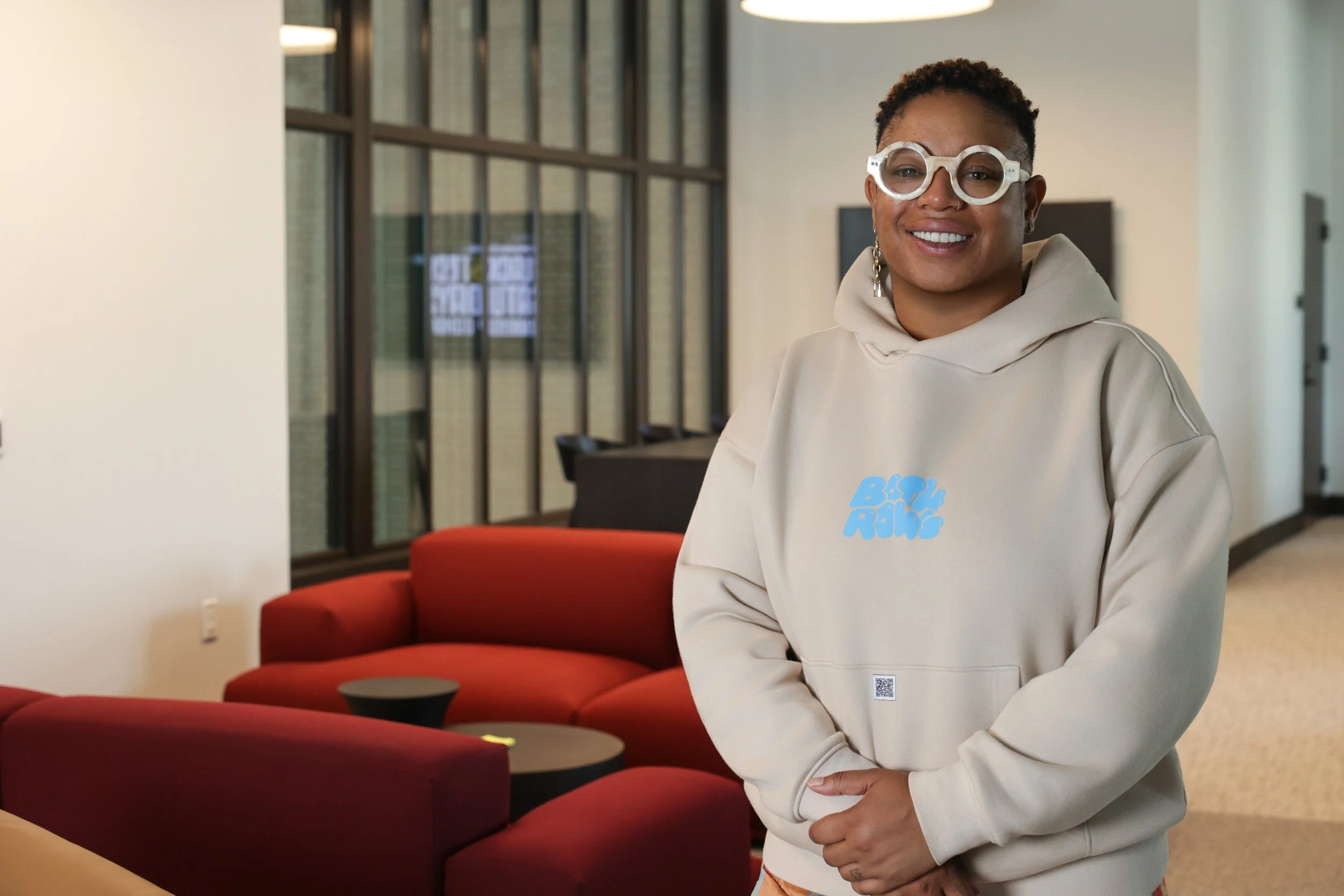
“Britney Epps founded House of Both Rows to make sustainable fashion local, accessible, and Black-led — and Detroit’s creative economy is better for it.”
Inside THE ETHER DETROIT on a weeknight, Britney Epps had her laptop still open from her tech job. Around her: fabric, clothing, sketches, and the early architecture of a brand she had been carrying for longer than most people knew about. She was not unwinding from the day. She was building through it — pulling between two worlds that, for her, were never really separate.
That night, something clarified. Not a decision so much as a recognition. She was not simply interested in fashion. She was studying it, building through it, seeing how it could hold everything she cared about — access, sustainability, technology, and community — in one coherent place.
House of Both Rows was already real. What shifted was understanding exactly what kind of real it was.
Britney Epps is the founder and Lead Designer of House of Both Rows, Detroit's first sustainable fashion house. She introduces herself plainly at BTS events, but her self-declared arc reaches further: she is becoming a bridge — between fashion and technology, between creativity and community, between what the city already has and what it still needs.
That is not a tagline. It is a structural ambition. House of Both Rows is built on the premise that upcycled materials, convertible design, and community-centered access are not design constraints — they are the design. Epps is not softening fashion to make it more palatable. She is rebuilding what fashion is allowed to be.
Detroit is not a city without fashion talent. It is a city where fashion talent has historically been underresourced, underplatformed, and asked to prove viability before being given the tools to build it.
The structural pressures are not abstract. The U.S. EPA reported that Americans generated 17 million tons of textile waste in 2018, with 11.3 million tons — roughly two-thirds — going directly to landfills. That number has continued to climb alongside fast fashion's growth. Meanwhile, the market's proposed corrective — sustainable, ethically produced clothing — has largely priced itself out of reach for working-class consumers and emerging designers alike.
In Detroit, that contradiction lands with particular weight. The city's median household income is $39,938, and 32.7 percent of residents live in poverty, according to U.S. Census data. Sustainable fashion cannot be a luxury export from this city. If it is going to matter here, it has to be built with economic realism at its foundation — local production, accessible pricing, and community ownership of the supply chain.
The capital landscape compounds the challenge. In 2025, Black founders received just 0.32 percent of U.S. venture capital funding. The gap between the ambition Detroit's creative economy requires and the investment it actually receives is not a gap the market is closing on its own.
House of Both Rows is being built into that gap — not around it.
Capital and capacity have been the hardest constraints. Epps has built House of Both Rows while managing full-time tech work, periods of unemployment, studio costs, and production demands — all while carrying the additional burden of market education. There was no existing template for what she was building: a sustainable fashion house in Detroit, founded by a Black queer woman, designed to be beautiful, functional, and financially accessible at once.
The system was not engineered for this combination. That meant Epps had to build the brand, create the infrastructure, educate potential buyers on why this matters, and hold price accessibility as a core value — simultaneously, with limited runway, and before any institutional resources arrived.
The hinge was not a single dramatic moment. It was the accumulation of that night at THE ETHER DETROIT — laptop open, fabric on the table, tech job still running in the background — resolving into clarity. She was not waiting to feel ready. She was already doing the work. The question was whether she would take it seriously enough to build around it.
She did.
One of Epps's first structural moves was bringing in an operating partner and a creative director. That decision, she says, was what made the business feel viable — not because it added ideas, but because it added systems. House of Both Rows needed structure, storytelling, and scalable infrastructure, not just more creative output.
From there, she built on tools available to her: Shopify to sell, Milanote and Notion to organize client projects and brand systems, Canva and ChatGPT to shape visual language and communication. THE ETHER DETROIT became the physical home — for fittings, production runs, community events, and the kind of creative planning that does not happen over Slack.
The hard lesson she names plainly: the work cannot speak for itself if no one sees it. She has had to learn to create, document, explain, and sell the vision at the same time — even when the pull is to stay focused on making the thing. That tension between production and promotion is one most founders know. Learning to hold both without losing either is a discipline, not a phase.
Sustainable fashion built on upcycled materials and community access does not scale without proof that it sells. The perception that ethical design is a boutique indulgence — something for consumers with disposable income and designer budgets — is the specific myth House of Both Rows is working to dismantle. The early numbers are beginning to answer it.
House of Both Rows has completed two collection drops and crossed $1,000 in monthly revenue (self-reported). A commission process for custom work is active and growing. Between September 2025 and May 2026, the brand has been invited, applied for, or confirmed to participate in nine shows and activations (self-reported estimate). The first Both Rows Marketplace pilot is in development inside Chai Khana in Detroit — creating dedicated shelf space for sustainable artists and small product-based creators to sell alongside an established local business.
That last piece matters structurally: it is not just a sales channel. It is a proof-of-concept for what community-embedded distribution can look like for Detroit's sustainable creative economy.
What Epps is building is not only a fashion house. It is evidence — evidence that a Black-led, queer-founded, community-rooted sustainable brand can be commercially viable in a city where the odds of capitalization are stacked against all of those identities at once.
Evidence matters because the next creative founder in Detroit who wants to build this way needs to see that it is possible before they commit to trying. The absence of proof is its own barrier. When House of Both Rows demonstrates that upcycled design can sell, that a marketplace model can work inside an existing Detroit business, that fashion can be an economic tool rather than an economic escape — that demonstration lowers the cost of entry for the next person.
The broader truth is this: belonging creates builders, and builders create mobility. When Detroit's creative economy includes more Black founders working at the intersection of technology, sustainability, and design, the city builds more diversified economic pathways. Those pathways produce jobs, wealth, and the kind of civic infrastructure that stays local. Fashion is not peripheral to that story. In a city with Detroit's history of making things, it never was.
If you believe Detroit's next economy should be built by the people who have always lived and made things here, then follow @showbothrows and share House of Both Rows with one Detroit creative who cares about sustainability, fashion, or community. The work is already happening. What it needs now is a wider room.
