
Tia James Built a Career Doing Exactly What She Was Told She Couldn't
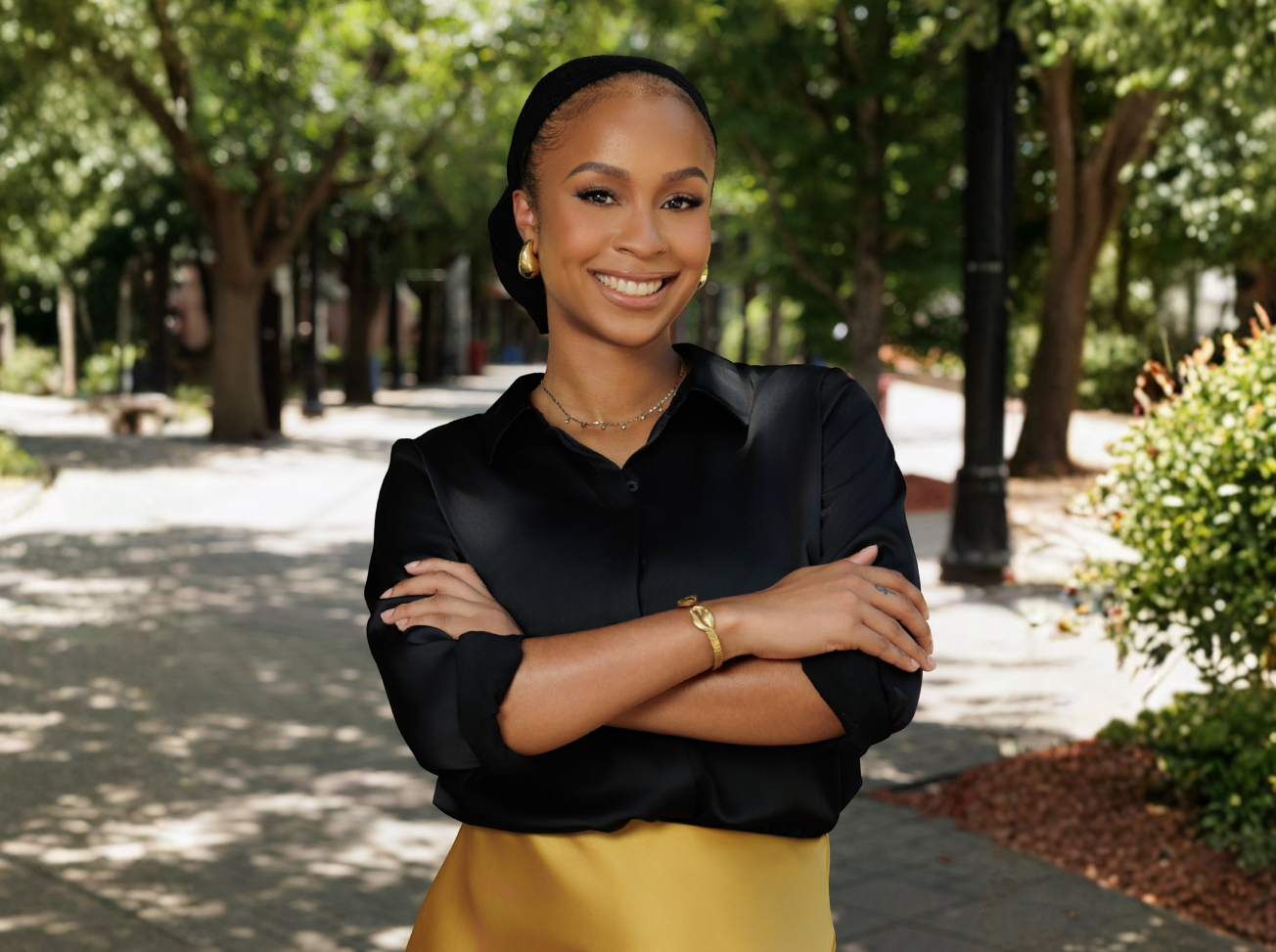
“Brand Identity director Tia James was told she’d fail for loving design. She built MonaDen Studios anyway — and now she’s making professional branding accessible to founders who need it most.”
In the spring of 2016, at the College for Creative Studies in Detroit, Tia James sat across from her professor during an end-of-semester review and talked about what she loved: designing graphic T-shirts and apparel. She was not seeking permission. She was sharing her vision.
What came back wasn't encouragement. She was told she wouldn't be successful on that path. That she wouldn't pass the semester.
She left the room, found a stairwell, sat down on the steps, and called her mother in tears.
Tia James describes herself as a Brand Identity Director — and, more precisely, someone becoming a creative leader by building spaces, stories, and brands where people feel seen, valued, and empowered to step into their truth. Today she serves in that role at Black Tech Saturdays, the Detroit-rooted movement building an ecosystem where Black and Brown founders don't have to leave to grow. She also runs MonaDen Studios, the independent design practice she launched full-time in June 2025, which serves entrepreneurs, nonprofits, and community organizations with branding, marketing, and creative strategy.
She is building a career doing exactly what she was told she couldn't.
What makes her story bigger than one designer's persistence is the structural problem her work is designed to solve.
Black founders in America are building real companies — and being systematically locked out of the capital and visibility that would let those companies scale. According to Crunchbase data from 2024, startups with a Black founder or co-founder received just 0.4% of all U.S. venture capital funding that year. That's not a talent deficit. That's a pipeline problem built on unequal access to networks, media attention, and the kind of professional storytelling that signals credibility to investors, partners, and customers alike.
Detroit sits at the center of this tension in specific ways. The city is home to one of the largest Black populations of any major U.S. metropolitan area — roughly 77% of Detroit residents identified as Black or African American in the 2020 U.S. Census — yet the city's tech ecosystem is still building the infrastructure to convert that population into ownership, not just labor. The gap between innovation and visibility isn't abstract here. It shows up in founders who are building real solutions and struggling to attract the attention those solutions deserve, not because their ideas are weak, but because they never had access to the design, branding, and storytelling tools that communicate quality to the outside world.
That is the gap Tia James has oriented her entire career around closing.
The barriers she faced weren't the kind that show up in loan denial letters or funding spreadsheets. They were internal — planted early and stubborn.
A professor's assessment in a college review doesn't stay in the room. It follows you. It sits down next to you in the stairwell. For Tia, that moment didn't just raise doubt about one semester — it raised a question she would spend years answering: whose judgment of her future was she going to trust?
Even after she chose herself, the friction didn't disappear. Building MonaDen Studios alongside full-time employment meant years of split attention, waiting for a "perfect moment" that the calendar never cleared. She was also, by her own account, more comfortable helping others tell their stories than claiming space for her own. Learning to be visible — to speak her truth as publicly as she applied her craft — became its own kind of development, running parallel to every Adobe Illustrator file she opened.
The hinge came not from a single decision but from an accumulation of evidence that the path was real.
She graduated from Eastern Michigan University and moved through a series of design internships — including work at Donor Advertising and The Lip Bar — that gave her technical range and professional footing. She built freelance experience. She served as a graphic designer for the City of Detroit. Each project added vocabulary to a design practice that was becoming distinctly hers.
Then came Black Tech Saturdays.
Working as Brand Identity Director and Lead Designer for BTS, Tia didn't just find a client — she found a community with a shared orientation. She designed event branding, merchandise, social campaigns, and large-scale experiences for a movement of founders who were building in real time. What she observed, across project after project, was consistent: the ideas were strong, but the branding often didn't reflect them. Many founders were showing up to rooms where first impressions are made in seconds, without the visual language to communicate the quality of what they'd built.
That observation became the foundation of her next move. She began developing educational resources around tools like Canva — not as a workaround to "real" design, but as a direct response to the access problem. Professional brand principles shouldn't require a professional design budget. If she could teach founders how to apply them using tools already in their hands, she could widen the circle of who gets to look credible.
In June 2025, she stopped splitting her attention. MonaDen Studios became her full-time work.
She will tell you what she learned the hard way: if you don't value your work, other people won't either.
Early in her freelance years, she undercharged, overextended, and said yes to projects that weren't aligned — convinced that working harder and charging less was the price of proving herself. It wasn't strategy. It was the market cost of unresolved self-doubt. The shift came when she stopped trying to earn validation through availability and started recognizing that her experience, perspective, and creative instincts were the service — not interchangeable commodities to be discounted toward the right price.
"Your worth is not determined by what someone is willing to pay you," she says now. That's not a saying she borrowed. It's a line she earned.
The receipts from that bet on herself are early but real.
Since launching MonaDen Studios full-time in June 2025, Tia has completed more than 10 client projects (self-reported, estimated) supporting entrepreneurs, nonprofits, and community organizations. As Brand Identity Director for Black Tech Saturdays from 2024 through 2026, she shaped the visual identity, event experiences, merchandise, marketing campaigns, and community-facing design across a growing ecosystem of founder-focused programming and large-scale conferences in Detroit. She is currently developing a Canva-based course aimed at founders and small business owners who need professional branding without a professional design budget.
This is a practice one year into its full-time chapter. The scoreboard is still being written — which is precisely the point.
What changes for the next person, if Tia James wins?
The most direct answer is: they see proof. A young designer who sat in a room and was told her passion wasn't viable sees someone who built a career doing exactly that. A founder who assumed professional branding was reserved for companies with real budgets discovers that the tools and the knowledge are becoming more accessible — because someone decided to teach them.
But the stakes reach further than one designer's redemption arc. When professional branding and storytelling become more accessible to Black and Brown founders, the credibility gap narrows. When the credibility gap narrows, more founders get taken seriously in the rooms where capital moves. When more founders get taken seriously, Detroit's tech ecosystem becomes something it is working, with real effort and real cost, to become: a place where innovation and economic mobility aren't reserved for the people who already had networks.
Tia James's work lives at that intersection. Design is not decoration. In the hands of founders who've never had access to it, it is infrastructure.
If you believe that who gets seen shapes who gets funded — and that professional branding shouldn't be a luxury only established companies can afford — then the most direct thing you can do is check out the So on Brand Club, Tia's platform built specifically for founders and small business owners ready to build a brand that helps them get seen, remembered, and trusted.
It's out now: https://soonbrandclub.podia.com/
Follow her on Instagram: @MonaDenStudios. And if you know a founder who's building something real but struggling to communicate it, send this story their way.
The vision was always there. The audience is catching up.
