
Rachell Dumas Is Building What Healthcare Never Had
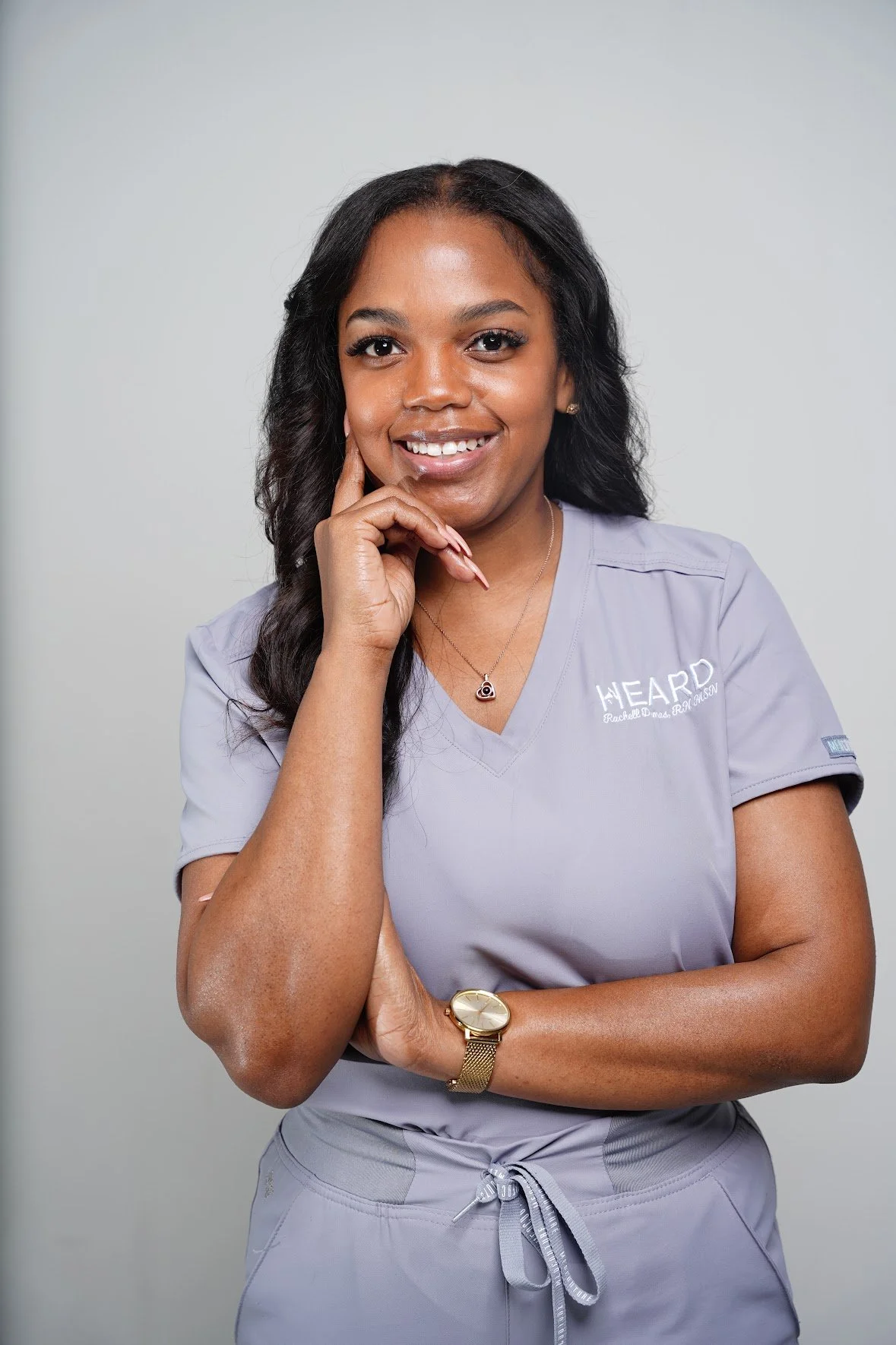
“Atlanta nurse and health tech founder Rachell Dumas built HEARD after a dismissed ER visit nearly cost her life. Now she’s building the patient advocacy infrastructure millions need.”
It was a summer afternoon in 2023, inside an Atlanta emergency room.
Rachell Dumas — registered nurse, new mother, six months postpartum after nine pregnancy losses over four years — arrived presenting stroke-like symptoms and sudden vision loss. She was sent home with a diagnosis of stomach virus.
She knew, the way nurses know, that something was wrong.
Months later, a neurological diagnosis confirmed it. The condition required multiple brain surgeries. And in the gap between that dismissed ER visit and the operating room, a company was born — not from inspiration, but from necessity. That afternoon, Dumas understood something that her nursing training had circled for years but never named plainly: patients needed infrastructure. Not encouragement. Not pamphlets. Infrastructure — a real-time way to document concerns, escalate issues, and be heard before harm occurs.
Rachell Dumas is a registered nurse, patient advocate, and health tech founder based in Atlanta, Georgia. She is the CEO and founder of HEARD, an AI-powered platform designed to help patients and caregivers navigate healthcare, document concerns, and escalate issues before harm reaches them.
She describes her arc plainly: she is becoming the builder of patient advocacy infrastructure by building HEARD — filling a gap that the healthcare system designed, then left unaddressed for generations of patients, caregivers, and families who trusted the system and were failed by it anyway.
She came to this work carrying both a clinical credential and a patient number. That double position — insider and subject — is not incidental to what HEARD is. It is the architecture of it.
Rachell Dumas is not solving a niche problem.
The World Health Organization estimates that 1 in 10 patients is harmed while receiving healthcare. In the United States alone, nearly 800,000 Americans die or become permanently disabled each year due to diagnostic errors, according to research published by the Agency for Healthcare Research and Quality and cited by the National Academy of Medicine. These are not edge cases. They are systemic failures — structural outcomes produced by a system that was never built to center the patient's voice as a data source.
The economic dimension is just as stark. Employers lose an estimated $33 billion annually in productivity due to caregiving burden and healthcare-related absenteeism, according to findings from Harvard Business Review and the National Alliance for Caregiving — a figure that makes patient navigation not just a public health issue, but a workforce issue and a bottom-line issue for every employer benefits manager sitting across a negotiating table.
Meanwhile, the healthcare sector is contracting around the wrong pressure points. Staffing shortages, rising costs, and administrative overload have pushed health systems toward efficiency at the expense of communication. The patient, already the least powerful actor in the room, has fewer advocates today than a decade ago.
That is the market HEARD is entering. And that is the infrastructure it intends to build.
The obstacles were structural, and they stacked.
Dumas was building a health tech company as a Black woman founder — entering a venture capital ecosystem where, by widely reported industry data, Black women receive less than 1% of all VC funding. She was doing it while recovering from a life-threatening neurological condition, learning startup fundraising without a Silicon Valley network, and navigating the same healthcare system she was trying to fix — now as both clinician and patient.
The credibility gap was its own kind of tax. Patient advocacy, she found, was often perceived as a social cause, a nonprofit problem, a soft issue. Convincing early stakeholders that it was also a scalable technology and infrastructure opportunity — that the same patients who were being dismissed were also a market, and that the caregivers drowning in fragmented systems represented a product category — required a different kind of proof than a pitch deck could provide.
She had the clinical knowledge. She had the lived experience. She had the solution. What the system wasn't offering her was the door.
The hinge didn't come in a boardroom. It came in a hospital bed.
The same system that dismissed her symptoms, that sent her home with the wrong diagnosis, that required her to draw on nursing training just to advocate for her own survival — that system became the blueprint. Not for what to replicate, but for what to replace.
Dumas made the choice most people don't: she turned the moment of harm into a design document. The ER visit wasn't just a personal trauma. It was a product specification. And she built accordingly.
She started where she was.
Dumas sketched HEARD's initial workflows from her own patient experience and nursing practice — the documentation gaps, the escalation breakdowns, the moments where clinical knowledge and institutional process failed to connect. She used Lovable to build the initial platform, learning product development in real time alongside the recovery from brain surgery.
She found community at Black Tech Saturdays, where she began learning the language of startup development — pitch structure, go-to-market thinking, founder networks. She joined NVIDIA Inception for technical mentorship and Pipeline Angels for investment validation. Healthcare leaders, clinicians, patient advocates, and early beta users shaped the product through continuous feedback cycles.
The first angel investment — $30,000 (self-reported), secured through SAFE agreements — was the first external confirmation that what she was building had a market, not just a mission.
What she learned the hard way: building the technology was the easier part. "Building trust, relationships, and a scalable business around it — that's the real challenge," she says. She had the right solution. She still had to learn fundraising, sales, partnerships, and storytelling. No one told her that going in.
When a Black woman founder in health tech tells you patients are being harmed because no one gave them the tools to document and escalate their own care, she is not describing a gap she imagined. She is describing the gap the industry's own data confirms — and that she survived.
Here is what HEARD has built since its 2025 founding:
- Beta platform developed and live (self-reported)
- More than 1,600 users and supporters in the HEARD community (self-reported)
- First angel investment secured through SAFE agreements, totaling $30,000 (self-reported)
- Accepted into NVIDIA Inception, Nasdaq Entrepreneurial Center Milestone Circles, Peachscore Accelerator, and Pipeline Angels — all in 2026 (self-reported)
- Currently transitioning from beta to revenue generation, pursuing pilots with employers, healthcare organizations, and community health partners (self-reported)
- Media features, speaking engagements, and expanding strategic partnerships (self-reported; specific outlets not provided)
HEARD is pre-revenue and in active growth. These figures represent early-stage momentum, not scale. The infrastructure is being built.
What changes if HEARD succeeds is not just Rachell Dumas's outcome. It is the proof of concept.
The next patient who arrives in an emergency room with symptoms that don't fit a quick diagnosis — they get a tool instead of a pamphlet. The next caregiver managing a parent through a fragmented hospital system — they get documentation infrastructure instead of a phone tree. The next nurse who has seen the system fail patients for twenty years and decides to build the fix — they see that lived experience is a design credential, not a liability.
And the next Black woman founder with a solution that emerged from survival — she sees a path.
Healthcare innovation, historically, has been built by those with access to institutions and capital. HEARD is evidence that the most urgent innovations may come from those who were failed by those institutions first. That reordering — of who builds, who designs, who defines the infrastructure — is not just equity. It is better engineering.
When the people who've been harmed by a system build the tools to fix it, everyone's outcomes improve. That is not a moral argument. That is a public health argument. And it is an economic one.
Rachell Dumas is not asking for sympathy. She is asking for distribution.
If you are a healthcare leader, an employer benefits manager, a hospital executive, or an investor who believes that patient outcomes are a technology problem with a market solution — HEARD is ready for that conversation.
Share www.myheardapp.com with someone who has the power to move it forward. The infrastructure exists. The patients are waiting. The only question is who shows up to make sure they are heard.
