
RK Beale Took a $100K Pay Cut to Build a Career in IT.
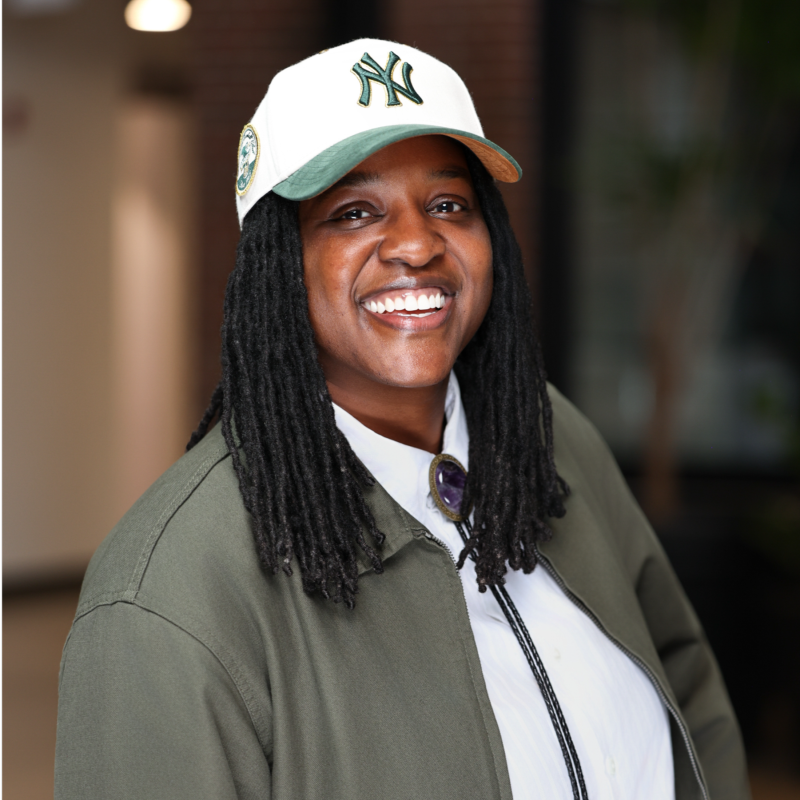
“RK Beale left LinkedIn sales, took a $100K pay cut, and taught herself cybersecurity. Now she’s a Lead in government IT — and she’s showing Detroit the way in.”
It was a coffee chat at EventsDC in December 2023, not a conference keynote, not a career fair, not a formal pitch. Just a conversation. RK Beale sat across the table from someone in tech, asked the kinds of questions she had always asked to get to the bottom of things, and walked away with a decision already forming in the back of her mind. She was done with sales. Not burned out. Not pushed out. Done, in the deliberate, irreversible way that happens when a person finally hears something click.
She was leaving a Tech Sales role at LinkedIn. She had no formal technical training. She had no certification, no degree in information systems, no help desk history. What she had was a career built on reading rooms, building relationships, and solving problems by asking the right questions. She had, without knowing it, been building the first half of an IT career.
The second half was about to begin.
RK Beale introduces herself plainly: Customer Operations and Experience Lead, Detroit. But what she is becoming is something the title hasn't caught up to yet. She is becoming a technical voice, not by inheriting access, but by building stories that create a pathway into IT for people who have never seen a road into the field with their name on it.
She is a builder of on ramps. And right now, Detroit needs that more than it needs another closed door.
For a city betting its next chapter on a technology economy, Detroit faces a pipeline problem it cannot afford to ignore. The 2024 CompTIA State of the Tech Workforce report found that just 1 in 12 IT workers in the United States is Black, roughly 8 percent of a workforce that controls the digital infrastructure of nearly every industry in the country. The gap is not a talent problem. It is a structural one: a compounding absence of visible models, accessible on ramps, and communities that say plainly, this field is for you too.
The economic consequences reach beyond IT. According to the Bureau of Labor Statistics, information technology occupations are among the fastest growing in the country, with the sector projected to add hundreds of thousands of jobs through the next decade, jobs that come with wages, benefits, and mobility. When Black workers are systematically underrepresented in that growth, an entire community is excluded from one of the clearest paths to economic stability in a post industrial economy.
Detroit has something IT needs: a culture of creativity, improvisation, and problem solving forged in environments where resources were never guaranteed. What the field has lacked is someone to name that plainly and build the bridge.
The certification system was the first wall. No one tells you that earning one certification can split into ten possible directions, and that without a guide or a community to orient you, it is easy to get funneled into entry level help desk work and stay there. The IT Help Desk Box, RK calls it, not a launching pad, but a ceiling disguised as a floor.
She had no technical background and no map. She had to find both.
The hinge was that coffee table at EventsDC. The conversation didn't hand her a plan. It handed her permission, or rather, it handed her the realization that she didn't need permission. She had been solving technical problems in the language of sales for years. The field wasn't foreign to her thinking. It was just labeled differently.
She left the table with her mind made up. December 2023. She walked away from the title, the compensation, and the familiarity and walked toward something she could not yet fully name.
She built it with what she had. She found a free networking course on YouTube by Professor Messer. She enrolled in a 12 week CompTIA Security+ class. She started talking about what she was learning, about the concepts she was absorbing, with system administrators and cybersecurity professionals she met along the way. The conversations became a feedback loop: learn, practice, speak, refine.
In January 2024, she stepped into her first IT role, carrying a pay cut of approximately $100,000 per year (self reported). She moved to Detroit in December 2024. She started IT contracting part time, then in April 2025 moved into a full time IT subcontracting role as a Junior Business Analyst.
The hard lesson came from the exam. She scheduled her Security+ test for the week after completing her course, convinced the material would be fresh enough to carry her through. It wasn't. She failed. She describes it plainly, without self pity: she had to retake the test. She passed in October 2024.
Then came the government shutdown, 43 days (self reported). With the contract slowed and the team stretched, RK volunteered for QA testing. She had never written a test case or run a QA process in her life. She took notes. She led team ice breakers. She held things together in the way that people do when they decide the work matters more than the job description. The leaders on the contract noticed.
The numbers in RK's story matter because skeptics will look at a career pivot this steep, no technical degree, no help desk foundation, no formal pipeline, and assume the math doesn't work. It does.
January 2024: Entered IT for the first time, accepting an approximately $100,000 per year pay reduction (self reported)
October 2024: Passed CompTIA Security+ certification exam (self reported)
December 2024: Relocated to Detroit, began IT contracting part time (self reported)
April 2025: Secured a full time subcontracting role as a Junior Business Analyst (self reported)
October 2025: Volunteered as QA Tester during a 43 day government shutdown, with no prior QA experience (self reported)
April 2025 (updated): Interviewed for and was offered a full time Lead role with the contracting company, with benefits and a salary described as one she could be proud of (self reported), based in part on the professional equity she built during the shutdown period
No external funding. No legacy network. No credential that came easy. What built this career was the same thing that built her sales record: relationships, questions, and refusing to wait for an invitation.
What RK Beale's story does for the next person is more than inspiration. It is documentation. It is proof of mechanism, a visible, replicable sequence of steps taken by someone who started with nothing that the traditional IT hiring system would recognize, and arrived at a leadership position in under two years.
When Black professionals see only 1 in 12 faces in IT that look like theirs, the implicit message is that the field has already decided who belongs. Every story that runs against that assumption is a structural correction, not a feel good exception, but evidence that the exclusion was never about aptitude.
Detroit's economic future depends on whether it can move its people into the sectors building that future. That means IT. That means cybersecurity. That means operations, quality assurance, and technical project management. And it means having more people like RK, inside the rooms, telling the truth about how they got there, so the next person doesn't have to figure it out alone.
Belonging creates builders. And builders, here in Detroit, create the economy the city has been promised.
Update your LinkedIn profile. Update your resume. Put the real world experience you have been living on the page, the QA testing you did without a title, the systems thinking you practiced without a certification, the problems you solved without anyone calling you technical. Don't downplay your skillset because no one handed you a credential for it. RK Beale didn't wait for the field to recognize her. She went in, built the record, and earned the offer.
If you are rooting for Detroit's tech ecosystem to reflect the city that actually lives here, then find RK Beale, follow her work, and tell someone who's sitting on that decision, the one that feels too steep, too late, too without a roadmap, that the road exists. Someone already built it.
