
Ederique Goudia Built the Infrastructure Detroit's Food Entrepreneurs Need
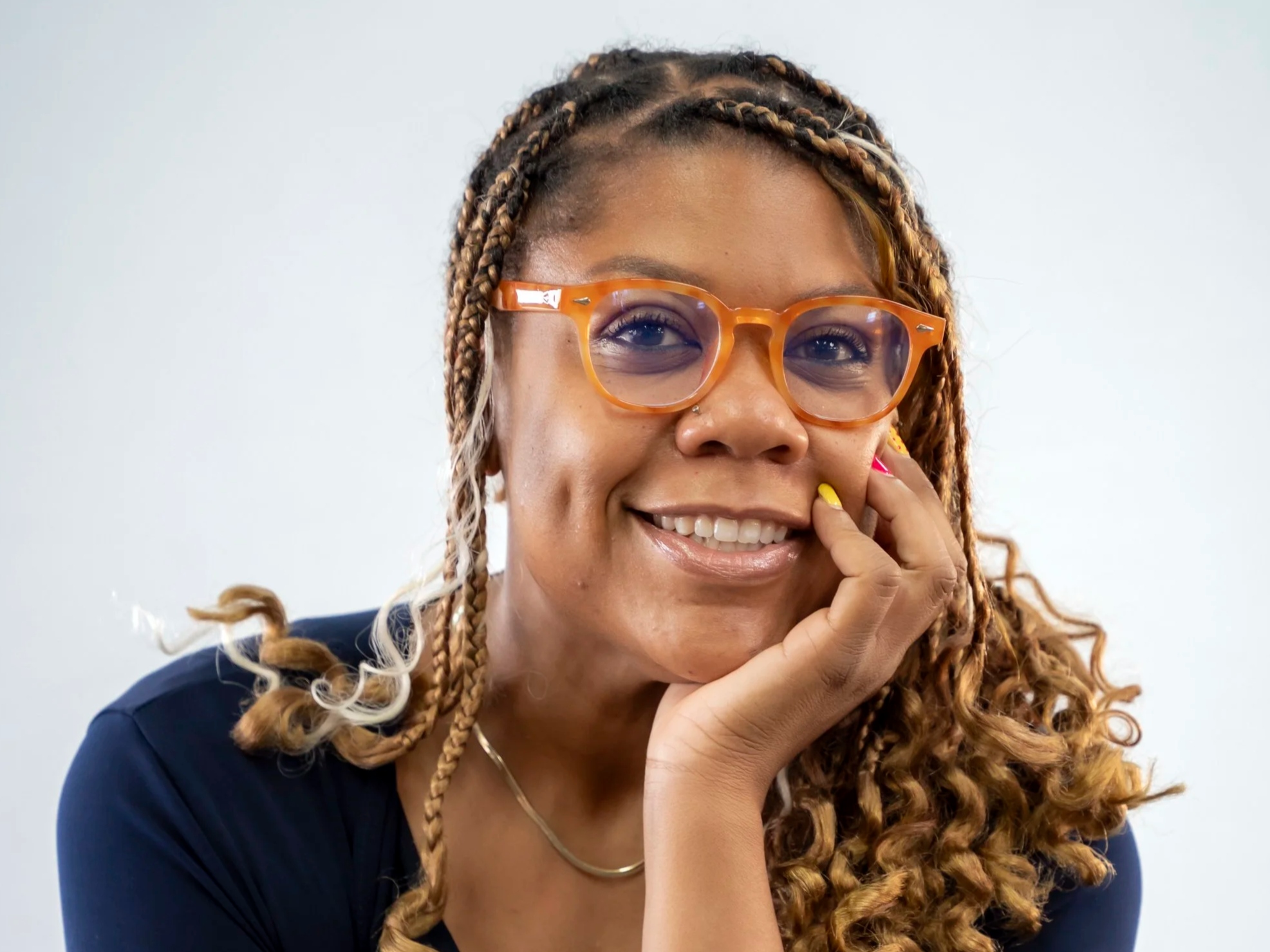
“Chef E turned a 2016 FoodLab moment into In the Business of Food — technical assistance, training, and real infrastructure for Detroit’s under-resourced food entrepreneurs.”
It is 2016, and Ederique Goudia is sitting inside a FoodLab Detroit program room, listening.
Around her, food entrepreneurs are describing what they are trying to build — neighborhood restaurants, retail food products, catering concepts. They have strong ideas and real vision. What Goudia notices, with the clarity of someone who has spent more than a decade inside foodservice management and food distribution, is the gap between what these entrepreneurs are carrying and what they would need to survive.
She can see it exactly. Not as a theory. As a technical problem she already knows how to solve.
"They had talent, strong products, and real vision," she says. "What they needed was the know-how, technical assistance, resources, and opportunities to turn those ideas into real businesses instead of hobbies or side hustles."
That afternoon, Ederique Goudia — known across Detroit's food community as Chef E — began to see her own experience differently. Not just as a career. As a bridge.
Ederique Goudia is the founder of In the Business of Food, a Detroit-based technical assistance organization serving food entrepreneurs. She describes her work not as consulting in the narrow transactional sense, but as stewardship — of an ecosystem, of a pipeline, of the people building Detroit's food economy from the ground up.
"I am becoming a steward of Detroit's food ecosystem," she says, "by building the support system food entrepreneurs need to turn their ideas into sustainable businesses."
That framing matters. It names what this work actually is: not coaching individuals toward personal success, but constructing the infrastructure that didn't exist before she arrived.
Detroit has never been short on food talent. What it has been short on is infrastructure.
The food industry is one of the largest economic engines in the country. The National Restaurant Association projects that restaurant and foodservice sales will reach $1.55 trillion in 2026. And yet the same industry report found that 42 percent of operators said their restaurants were not profitable in 2025 — a number that lands harder in cities where capital access was unequal long before the first oven was turned on.
In Detroit, that inequality has a specific shape. The Chicago Federal Reserve found that Black residents make up 78 percent of the city's population, but Black-owned businesses represent only 10 percent of Detroit's businesses — and those businesses reported average monthly revenues of $1,382, compared to $17,784 for non-Black-owned businesses. That is not a talent gap. That is a structural gap, built over decades, expressed in licensing costs and distribution contracts and startup capital that never arrived.
The food economy is growing. The question is whether it grows in a way that includes the people who have always fed this city — or whether it extracts value from their neighborhoods while leaving them on the margins of the industry they built.
That is the gap Goudia is working inside.
When Goudia began building In the Business of Food, the friction was both practical and systemic.
She had industry knowledge — deep, specific, earned across foodservice management and food distribution — but she did not have a major funder or a ready-made platform. She was doing four things simultaneously: creating programs, supporting entrepreneurs, proving there was a need, and searching for the resources to meet it.
The hardest part, she says, was recognizing that the entrepreneurs who most needed technical assistance were often the least able to pay for it. Workshops built trust. They did not always convert into consulting engagements, because the people she was trying to reach were already stretching every dollar.
And behind that individual constraint was the systemic one: the people and organizations closest to this problem — embedded in communities, fluent in its texture — still had to fight to be trusted, funded, and taken seriously.
"I was building from community trust, lived industry experience, and the belief that support should be treated as infrastructure," she says.
The hinge is visible inside that 2016 FoodLab room, but it is not the moment Goudia had an idea. It is the moment she made a choice about what her experience was for.
She had the technical knowledge to diagnose what these entrepreneurs were missing. She had spent years learning the back-end of food businesses — not just the cooking, but the costing, the distribution, the licensing, the operational systems that determine whether a food business survives or doesn't. And she was sitting in a room full of people who needed exactly that.
The choice was to stop being a person with relevant experience and start being the infrastructure. To make her knowledge public, structured, and accessible — to build the on-ramp rather than wait for one to appear.
FoodLab Detroit didn't just help Goudia see the gap. It became her first client and first contract — a concrete foundation on which to build.
She started with the tools available: a Squarespace website, a Mailchimp list pulled from the FoodLab Detroit listserv, and workshops designed to reach food entrepreneurs where they already were. The workshops were deliberate — not just educational programming, but trust-building infrastructure. Entrepreneurs could ask real questions and see that Goudia understood both the craft and the business side.
In 2017, she became a certified ServSafe Food Safety Manager Instructor and Proctor — a credential that gave her a formal, verifiable role in an area where food entrepreneurs routinely struggled. From there, she kept building: pricing support, licensing guidance, production costing, operational systems — turning what she knew from the inside of the food industry into structured programs other people could use.
When she hit the wall on the consulting model — the realization that the people who most needed the work couldn't always afford to pay directly — she changed the architecture. She moved toward partnerships with nonprofits, business support organizations, and ecosystem partners. The support would be funded differently so it could reach the entrepreneurs who needed it most. By 2019, ProsperUs Detroit was her second contract. By 2022, she was working with Detroit Public Schools Community District, Detroit Food Academy, and Make Food Not Waste. In 2024, she took on management of the Eastern Market Shed 5 Incubator Kitchen.
The model she built isn't a side hustle that became a business. It's an infrastructure that became a system.
Under-resourced food entrepreneurs have always been told that the market will sort it out — that good products find their way. What that framing ignores is how much technical knowledge, legal guidance, and operational infrastructure separates a great idea from a sustainable business. Goudia's numbers make the case for what happens when that support actually exists.
Since beginning this work, In the Business of Food has reached more than 2,000 entrepreneur touchpoints (self-reported), completed 204 Ask an Expert appointments (self-reported), and logged 6,120 technical assistance minutes (self-reported). The Now Serving newsletter has grown to more than 1,000 subscribers (self-reported). More than 400 food entrepreneurs have earned ServSafe Food Safety Manager certifications through her instruction (self-reported), and 120 cohort participants have graduated from her programs (self-reported).
In 2025, she received a $20,000 Seed Award from the MI Good Food Fund — a named public fund supporting food businesses in Michigan.
The work has been recognized by National Geographic, Bon Appétit, Food & Wine, Eater, NPR, the Detroit Free Press, Hour Detroit, and WDIV. In 2026, the Detroit Historical Society named her a Hustle Honoree.
These are not vanity metrics. They are the shape of a support system that now exists where one didn't before.
The next food entrepreneur who walks into a program room in Detroit will not have to figure this out alone.
That is the shift Ederique Goudia's work is making possible — not just for individuals, but for the ecosystem. When technical assistance is treated as infrastructure rather than a luxury, the path from idea to sustainable business gets shorter. Entrepreneurs spend less time searching for basic guidance and more time building. They make fewer expensive mistakes, price their products correctly from the start, and understand the licensing landscape before it costs them.
That matters for individuals. It matters more at scale.
Detroit's food economy is a real economic engine — one that employs people at every skill level, anchors neighborhoods, and generates revenue that can stay local. But an engine that runs on the labor and creativity of Black entrepreneurs while returning a fraction of the revenue to them is not a thriving ecosystem. It is an extraction model with a better aesthetic.
Belonging creates builders. Builders create economic mobility. And economic mobility — real, durable, community-rooted mobility — is what distinguishes a city that is growing from a city that is simply changing hands.
If Detroit's food economy wins, it has to win for the people who built it. That requires infrastructure. Goudia is building it.
The work is real, the need is documented, and the path forward is clear — but infrastructure takes more than one builder.
If you believe that Detroit's food economy should grow in a way that includes the people who built it, here is what you can do right now: introduce In the Business of Food to one food entrepreneur, one funder, or one partner who can help expand the work.
One connection is not a small thing. In a support ecosystem, it is often the entire path.
Reach Ederique Goudia at eg@ibfdetroit.com, at ibfdetroit.com, or on Instagram at @inthebusinessoffood.
