
Dominick Lemonious Is Building Detroit's Blueprint at Liquor Basket Gratiot
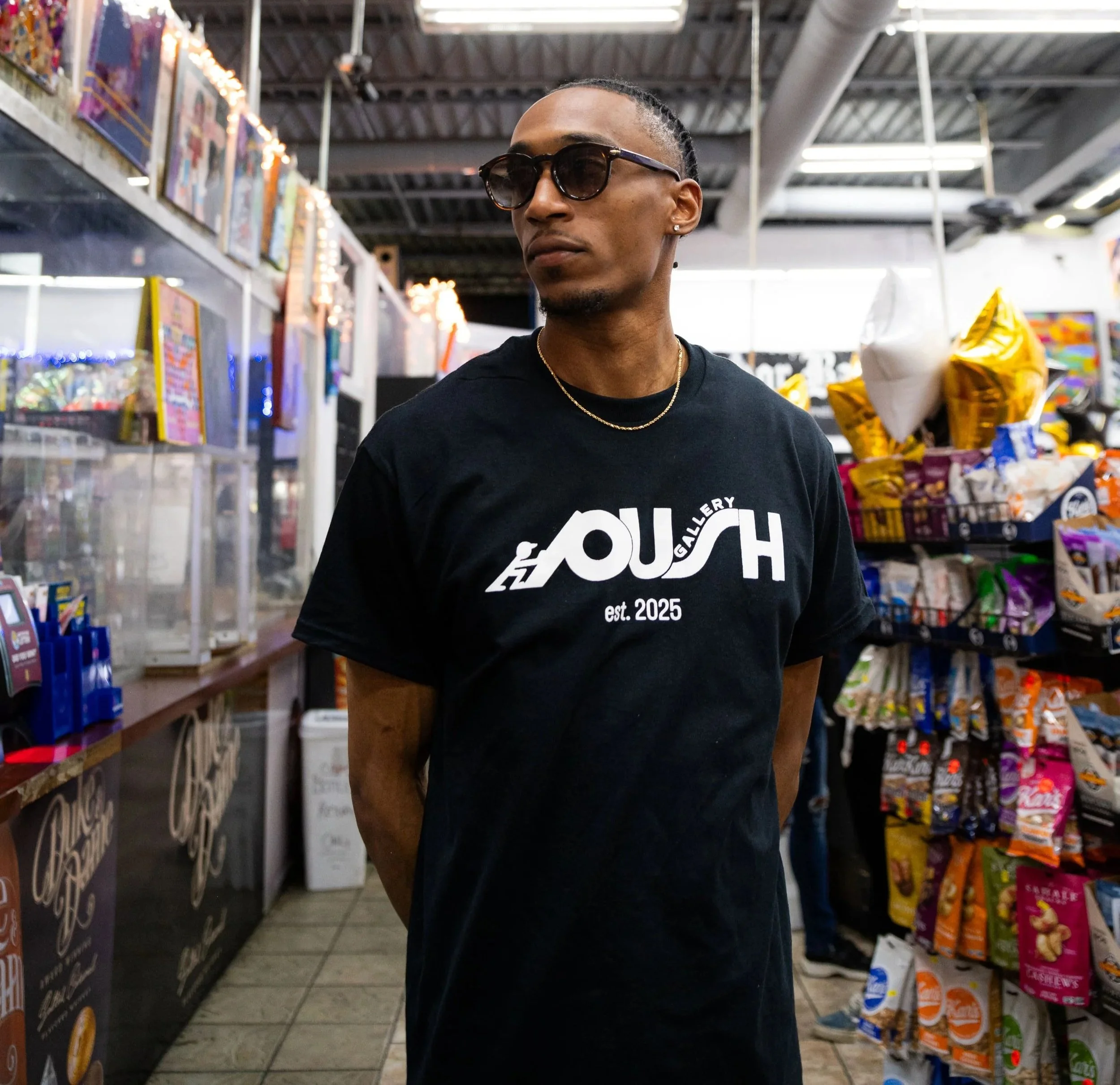
“In a city with only 3 Black-owned liquor stores, Dominick Lemonious turned Liquor Basket Gratiot into a gallery, a marketplace, and a movement.”
It is Saturday morning, June 13th, just after 10 a.m., and Liquor Basket Gratiot is already open on Detroit's east side. The shelves carry products you won't find at most neighborhood stores — Black-owned spirits, wines, household goods. Art hangs on the walls. The door swings open.
The first customer of the hour walks in and starts talking. Dominick Lemonious notices the accent. He asks about it. The man says he's from Dallas. He didn't come to Detroit for a concert or a game or a conference. He came because of what he'd seen on social media — the art exhibitions, the Black-owned vendor activations, the energy of the space. He made the trip from Texas to stand inside a liquor store on Gratiot Avenue.
That was the moment Dominick understood something he had been building toward without yet being able to fully name. The store wasn't just serving the block anymore. People were watching from places he hadn't imagined. What he had built on Detroit's east side had become, quietly and without permission from any institution, something that looked like a destination.
Dominick Lemonious is the Manager of Liquor Basket Gratiot and the Curator of Push Gallery Detroit. He is becoming, in his own words, "the curator of a global cultural hub right here on Detroit's east side." That isn't aspiration dressed up as a title. It is a declaration of intent made visible every week inside a working retail store — one that holds art on its walls, Black-owned brands on its shelves, and community programming under its roof, all at once.
He is building the intersection where commerce, culture, and community are not competing priorities. They are the same project.
Detroit's east side has long carried the economic weight of a city in structural transition. But inside that transition, the retail infrastructure serving Black neighborhoods has rarely been controlled by the people in those neighborhoods. Liquor stores are among the most visible fixtures of urban retail — and among the most extractive when they are owned by interests with no stake in the community they profit from.
The numbers make the structural problem plain. Out of 382 licensed liquor stores in the city of Detroit, only three are Black-owned (self-reported; BTS is seeking independent verification from the Michigan Liquor Control Commission). That is less than one percent of licensed liquor retail in a city where Black residents make up approximately 77 percent of the population, according to U.S. Census Bureau data. The gap between who owns the stores and who lives in the neighborhoods is not an accident. It is the product of decades of capital access barriers, licensing complexity, and the kind of institutional indifference that shows up in small, compounding ways: products not stocked, permits not extended, systems not built for you.
The Kauffman Foundation has documented consistently that Black entrepreneurs face higher denial rates on small business loans and are more likely to rely on personal savings rather than institutional capital to launch — a gap that limits scale from the very first day. That structural reality is the context in which Dominick Lemonious opened Liquor Basket Gratiot in October 2020, during a pandemic, and began asking a different set of questions about what a neighborhood store could be.
The friction was real and it was specific. Funding was hard to secure. In the early years, the store went months without top-selling products — not because of demand, but because the business was being passed over by distributors (self-reported). Competitors appeared to operate outdoor signage without consequence; Liquor Basket Gratiot was fined for it. It took five years of operation before the store's EBT system was fully functional — five years before customers who rely on food assistance benefits could fully transact in a store that was built, in part, to serve them. These are not abstract grievances. They are the kind of friction that accumulates quietly until it becomes the difference between a business that survives and one that doesn't.
Dominick did not wait for the system to resolve itself. He made a decision about what he could control: the inside of the store, and who he chose to build with.
The customer from Dallas walking through the door that Saturday morning was not a fluke. It was the compounded return on four years of deliberate choices — every collaboration, every artist hung on the wall, every vendor invited in to sample their product. The hinge wasn't a single moment. It was a posture: build the space you want to exist, and build it with people.
The architecture of what Lemonious built came from relationships, not from a playbook. Early on, he partnered with Lazar Favors of Taste of Black Spirits — a collaboration that gave the store both an education in the Black-owned spirits and wine market and a pipeline to bring brand owners directly into the store for sampling events. Knowledge and community-building arrived together.
For the gallery component, he worked alongside friends Elonte Davis, Oshun Williams, and Tzu Pore, who pushed him to hang art in the space and helped design the in-store hanging system. He watched how customers moved when art was on the walls. What he observed changed the scope of the vision. Push Gallery Detroit launched officially in 2024, opening an application process for artists to exhibit inside a working retail store — not a white-box gallery in a gentrifying district, but a Black-owned corner store on the east side of Detroit, already drawing foot traffic, already trusted by the neighborhood.
Community events followed the same logic. Customer appreciation days. Product samplings. Bottle signings. Neighborhood giveback activations. Lemonious had grown up patronizing Detroit corner stores his entire life. He had never seen one do this. He decided that wasn't a reason to wait — it was a reason to go first.
The receipts are specific. Since opening in October 2020, Liquor Basket Gratiot has hosted 45 in-store vendor activations and currently carries 110 different Black-owned products (self-reported). Since Push Gallery Detroit's 2024 launch, the gallery has presented 11 artist exhibitions featuring more than 200 artists, with over $15,000 in art sales recorded (self-reported). A man flew from Dallas to Detroit to visit a liquor store. That one is verifiable — he walked through the door.
These numbers do not exist in isolation. They represent shelf space held for brands that most neighborhood stores in Detroit will not carry. They represent artists who had a wall, and collectors — some from outside Michigan — who bought work they would not have found otherwise.
When Dominick Lemonious describes what it means for the Liquor Basket Gratiot to win, he isn't talking about himself. He is talking about a vendor whose product finally has consistent retail placement. An artist who connects with their first collector. A Detroit resident who walks into a familiar space and buys something made by someone from their city.
Push Gallery Detroit, if it continues to grow, is not just an asset for artists. It is a new entry point for Detroit into a global conversation about where fine art is made, shown, and collected. It widens the definition of who gets to participate in that conversation. And the surrounding community — the people who already walk through that door — gain proximity to a world that has historically made itself inaccessible.
Lemonious has said he wants to build the blueprint of how businesses support communities and how communities support businesses — moving forward together. That isn't a slogan. It's a structural argument: that retail, done right, is an act of economic solidarity. That the dollar circulating inside a Black-owned store, among Black-owned brands, in a Black neighborhood, is doing different and more durable work than the same dollar spent elsewhere. Detroit's broader economic future depends on whether that argument scales. Liquor Basket Gratiot is the prototype.
Dominick Lemonious needs what every blueprint-builder needs before the blueprint becomes infrastructure: visibility, capital, partnership, and the kind of press that sends the next customer from somewhere unexpected through that front door. If you are rooting for Detroit's east side to win — and for the city's economic story to include the people who have always lived here — follow @liquorbasketgratiot and @pushgallerydet, share the opportunities they post, and ask yourself what you can bring through that door.
