
Asim Williams Is Building Detroit's Road to Tech Leadership
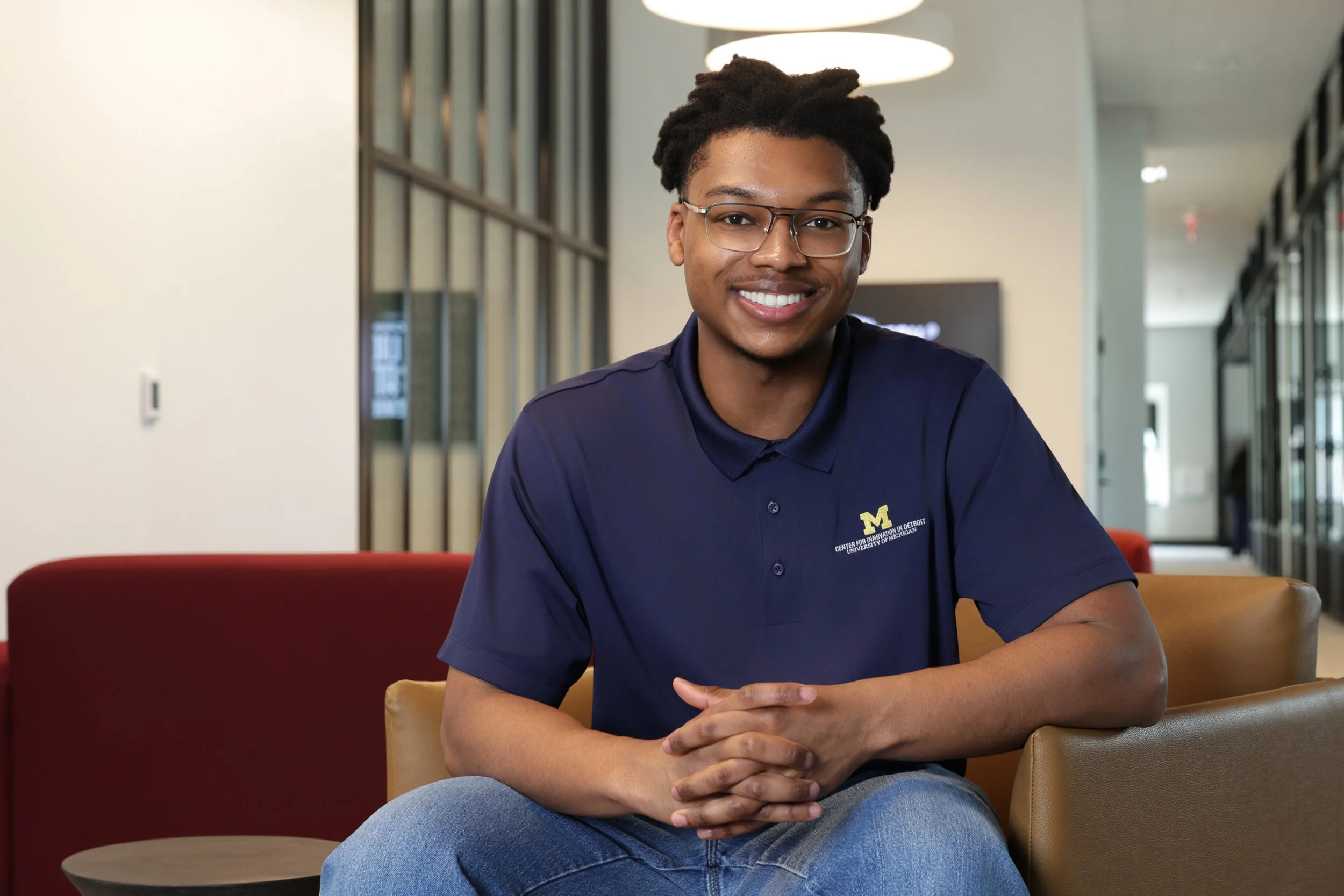
“Former Google engineer Asim Williams is constructing the STEM pipeline Detroit never had — one student stipend, one CS degree, one civic leader at a time.”
Michigan Central, summer of 2024. Inside one of Detroit's most storied redevelopment sites, young people from underrepresented communities were learning to build technology — not consume it, not marvel at it, but create it. Asim Williams was in the room, watching students engage code and systems and problems the way you engage tools you've just realized are yours to use. And then something clarified, the way things clarify when you are paying close enough attention: the road that should have brought these students here, the infrastructure of exposure, preparation, support, and credential that leads to technology leadership, had never been built. Not neglected. Not underfunded. Never built.
That distinction matters. It is the whole argument.
Asim Williams introduces himself the way people do when they mean all of it: family man, former Google engineer, and currently STEM workforce developer at the University of Michigan's Center for Innovation in Detroit. Each of those identities is load-bearing. The family man grounds the work in stakes beyond career. The Google engineer knows exactly what the road to that room looks like — and exactly what it costs when you arrive without it. The workforce developer at UMCI is doing the structural work, not the inspirational kind.
But what Williams is becoming is the frame that matters most. He describes his identity arc plainly: becoming the best in the world at collaboratively defining and communicating a vision of vibrant roads to civically minded technology leadership, and mobilizing ecosystems to build them — through trust and integrity. That is not a mission statement. That is an engineering specification. He is not trying to inspire Detroiters into tech. He is building the road that makes the trip possible.
Detroit's economic future is inseparable from its ability to produce technology leaders — not just workers, not just consumers, but founders, engineers, and civic architects of the digital economy. The numbers make the stakes plain.
STEM occupations are growing at roughly twice the rate of overall employment, and STEM workers earn nearly double the median wage across all sectors, according to the U.S. Bureau of Labor Statistics. Research from Georgetown University's Center on Education and the Workforce finds that STEM pathways offer workers approximately a 90% likelihood of securing what economists classify as a good job — defined as median earnings at or above $74,000 annually — the highest rate of any broad employment category. These are not soft projections. They are the current geography of economic mobility in America.
Now look at Detroit specifically. Roughly 60% of Michigan's 1.5 million Black residents live in the Detroit Metro area (self-reported; consistent with U.S. Census demographic patterns). Black residents make up approximately 80% of Detroit's population and its public school student body. And yet, in Detroit Public Schools Community District, only four schools offer AP Computer Science. Statewide, only 54 Black students passed the AP CS exam in any recent reporting cycle (self-reported). Meanwhile, national research consistently documents that Black students leave STEM pathways at disproportionate rates — leading in transfer-outs from CS programs even as demand for those credentials accelerates.
This is not an achievement gap. It is an infrastructure gap. The road was never built. The question is whether anyone will build it now.
Williams names the friction without flinching: it is structural, top-down and bottom-up simultaneously. The pipeline from first exposure to technology — through mastery, specialization, credentialing, and ownership — does not exist for Detroiters in any coherent form. There is no continuous road. There are scattered fragments: a program here, a camp there, a mentor if you're fortunate, a scholarship if you know where to look. What there is not is infrastructure. And Williams is precise about what that absence means: the system, he says, is functioning as it was intended to. That is not cynicism. That is diagnosis. And diagnosis is where repair begins.
The choice Williams made in that Michigan Central classroom in 2024 was not dramatic. It was architectural. He looked at what was absent — not just for the students in the room, but for the hundreds of thousands of Black Detroiters for whom those students stood as proxies — and decided that the answer was not better programming. It was infrastructure. Not another on-ramp to a road someone else built. A road, designed by Detroiters, for Detroiters, accountable to the community it serves. That reframe — from program to road, from intervention to infrastructure — is the hinge everything else turns on.
The infrastructure Williams is building is, in his own words, still very much under construction. He is working within the University of Michigan's Center for Innovation in Detroit, which gives him institutional leverage and ecosystem access. His tools are practical and accessible: the internet, social capital, and AI (he recommends Claude, specifically). His framing for the work is clarifying: all projects are just a series of unanswered questions, and the job is to find the right tools for answering them.
But tools only matter if the people around the table are the right ones. Williams credits a network of collaborators who have been essential to the work's early progress: Naomi Hill, Nando Felten, Sadeem Boji, Mary Jo Madda, Kyle Ali, Holly Arida, YouthTank Detroit, JustAir, Lauren Ruffin, and the full UMCI team. The road is being built by many hands. That is not coincidence — it is design. Infrastructure requires coalition.
What he has learned the hard way is implicit in the work itself: you cannot build a road alone, and you cannot build it without trust. Mobilizing ecosystems, as he describes his becoming, is not a management skill. It is a relational one. It takes longer than a grant cycle. It requires integrity as a structural material, not a value statement.
The critics of STEM pipeline work often argue that the programs are too small, too short-lived, and too disconnected from actual careers to move the needle on structural inequality. Williams is answering that argument with outcomes. As of June 2026 (self-reported):
- 80% of Code Next graduates are pursuing computational majors (self-reported)
- 100% of YouthTank's Engineering Practicum seniors are enrolled in CS or Engineering degree programs (self-reported)
- More than $250,000 in student stipends has been secured and distributed (self-reported)
- 2 high school student engineers have secured full-time software engineering offers (self-reported)
These numbers belong to students — Detroiters who are now inside the credential pipeline, not waiting at the edge of it. The stipends matter as much as the degrees: economic access is not separate from academic access. It is a prerequisite.
When Dug Song — a technologist and civic voice deeply embedded in Michigan's innovation ecosystem — articulates the conditions for regional growth, the equation is specific: young people seeking careers in growth industries, with startups, driven by founders and funders building a culture of innovation. Every variable in that equation requires the one before it. And the first variable — young people seeking careers — requires that young people can see the career, access the preparation, and afford the path.
What Williams is building is the missing infrastructure that makes Song's equation solvable for Detroit. If the road gets built, more Detroiters get paid. More Detroiters are prepared to succeed in rigorous STEM academia. More Detroiters are positioned to solve problems through innovation and entrepreneurship. Those are not soft outcomes. They are the economic and civic conditions for a city to become what it is capable of becoming.
And the implications extend beyond Detroit. When a majority-Black city produces a generation of technology leaders — founders, engineers, civic architects — it rewrites the story of who belongs in the rooms where digital infrastructure is designed. That rewrite matters for every city that looks like Detroit. It matters for the nation's ability to compete in an economy where, as the data consistently shows, the highest-probability path to economic security runs through STEM.
Legacy, in this frame, is not a personal achievement. It is a road that outlasts the builder.
Williams's ask is layered, which means it is honest: donate to YouthTank Detroit, study humanities and math and science and design, and write a letter to your representatives about something that makes you angry. That last one is not a throwaway. Civic infrastructure and technical infrastructure are built by the same force — organized people who refuse to accept that what was never built cannot be built now.
Detroit's capacity to become an equitable epicenter of wealth creation through technology leadership is not a question of talent. It never was. It is a question of infrastructure, investment, and political will. If you are rooting for Detroit — and for every city that has been told its young people are not ready — then fund the road, mentor the engineers, and make the call to your representative. The students are already there. They are waiting on us.
